Last reviewed: Sep 15, 2026
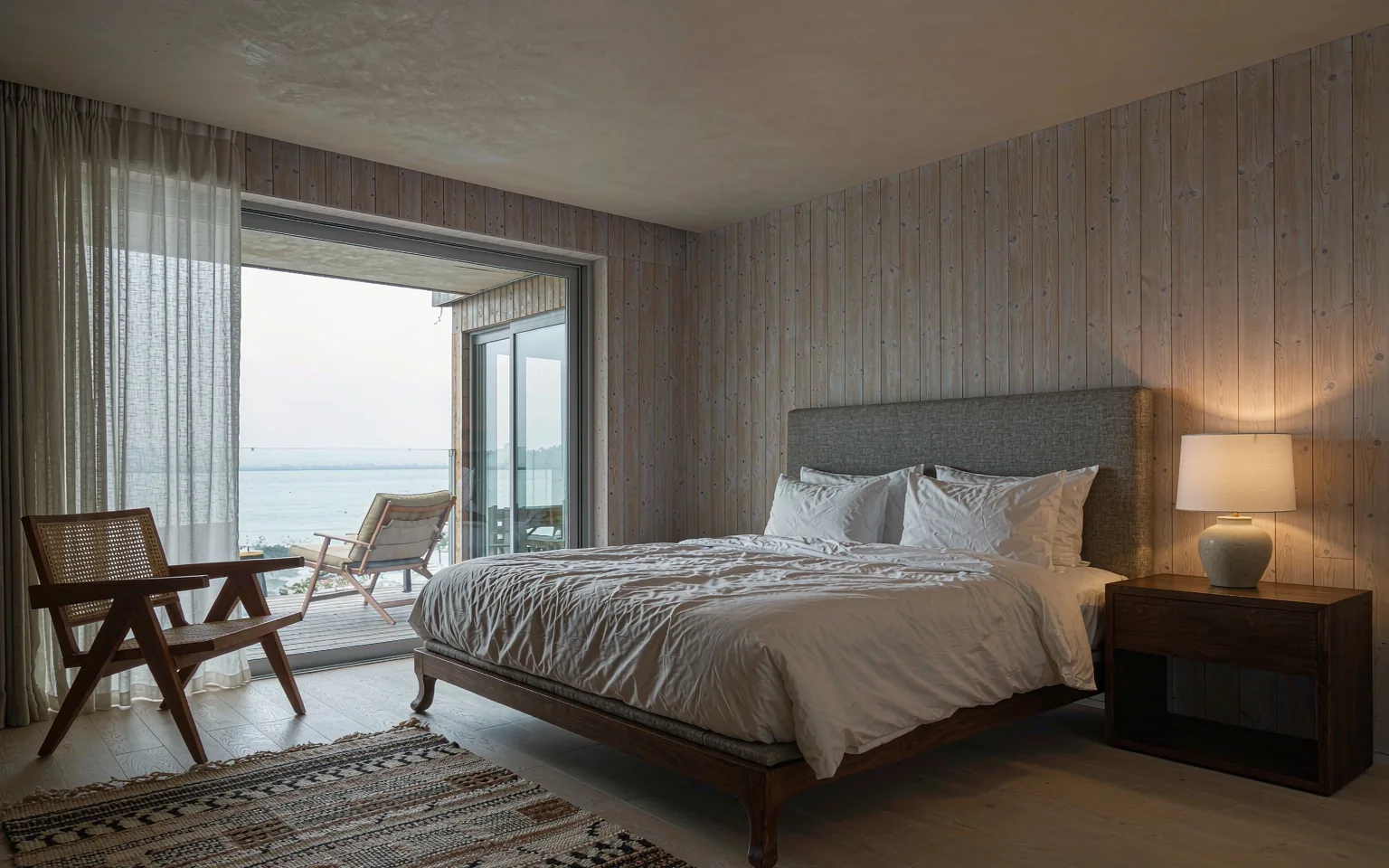
A reading room is the hardest quiet space to light well. The task is sustained, the users are still, the surfaces are usually matte and dark, and the people specifying the room are rarely the people who will sit in it for three hours. The standard response is to add ceiling light, which raises the overall level and makes the room worse: more glare off the page, more contrast between the page and its surroundings, and a flatter, more institutional feel. Portable lamps solve this problem better than most ceiling layouts, because they put light where the reader is rather than where the room is.
Why the ceiling is the wrong place to start
In a reading space, the eye adapts constantly between the page, the surroundings and the distance. A ceiling layout that delivers a uniform horizontal level does nothing about the relationship between those three surfaces. What matters is that the page is brighter than its immediate surroundings, that the surroundings are not dark relative to the page, and that nothing bright sits in the field of view. That is a local problem, and portable luminaires are a local solution.
This is the same reasoning that underpins Three Layers of Light, and Why One Fixture Cannot Do All Three, applied to a room where the task layer is the whole point. Ambient fill still matters — a dark room with one bright pool is tiring — but it should be provided by reflected light or by a second, dimmer layer rather than by turning up the overheads.
Where the lamps go, and why height matters
The height point is the one that gets specified least often and complained about most. A lamp that is too tall lights the ceiling; one that is too short lights the reader's face. Both are uncomfortable, and neither is fixed by changing the bulb. The room-by-room arithmetic for floor lamps is set out in What Height Should a Floor Lamp Be? A Room-by-Room Guide, and the same logic applies to a table lamp beside a chair.
- Beside a reading chair, the shade bottom should sit close to eye level for a seated reader — high enough not to glare, low enough that the light reaches the page rather than the ceiling.
- On a long shared table, table lamps at intervals beat a single central source, because each reader gets their own pool without casting a shadow across a neighbour.
- In stacks and circulation areas, an uplight lifts light to the ceiling and washes the aisle without putting a bright source in anyone's line of sight.
- At a catalogue or study carrel, a low-glare task lamp with a shielded source keeps the light on the desk and out of the eyes of the person opposite.
Glare, veiling reflections and the page itself
Reading surfaces are usually matte, but screens, glossy pages and laminated covers are not. A bright source reflected in a page is called a veiling reflection, and it is the main reason a reading space feels uncomfortable when the measured light level is perfectly adequate. The fix is geometry, not output: move the source so it does not reflect into the reader's eye, which usually means placing it to the side rather than directly in front or behind.
The same principle applies to study rooms with screens, and it is covered in more detail in Screen Glare: Why a Brighter Task Lamp Can Make Work Harder. For a mixed room — part reading, part laptops — assume the screen case is the harder one and place the lamps accordingly.
Colour temperature and output
For sustained reading, a warm-to-neutral appearance is usually more comfortable than a very cool one, and very warm light can make text feel muddy. The workable answer is to specify a single colour temperature across the whole room rather than a mixture, because a mix of two temperatures in one space reads as a mistake even to people who cannot name it. The trade-offs are covered in 2700K or 3000K? Choosing Colour Temperature for North American Interiors.
Output should be planned per position, not per room. The temptation is to specify one bright lamp per reading position; in practice, a moderate local source plus a soft ambient layer is more comfortable than one strong one. The method for working out how much light a room needs without guessing is in How Many Lumens Does a Room Need? A Working Method.
The operational side nobody specifies
Those four items are the difference between a specification that photographs well and one that still works in year three. A public reading room is a high-hours environment: the lamps are on all day, the users are different every time, and nobody reports a problem until it becomes a pattern.
- Switch position — a reader should be able to reach the switch from the chair without standing or hunting behind the shade.
- Cord routing — a portable lamp in a reading room sits against a wall or a table leg, and the cord exit decides whether it can.
- Cleaning — fabric shades in a public building collect dust, and the specification should say how they are cleaned or replaced.
- Replacement — spare lamps and spare shades should be ordered with the installation, not after the first failure.
If you are specifying portable lamps for a library, a study room or a reading lounge, send the room dimensions and seating layout to help@anrotix.cn and ask for a per-position schedule rather than a product list.
What this looks like in a real specification
A workable document names three things per position: the type of fitting, its height relative to the reading surface, and the colour temperature and output of the lamp that ships with it. It states the switch type and the cord length. It names the spare parts that will be held. That is enough for a purchasing team to buy consistently across a building and for a maintenance team to replace a unit in three years without guessing.
The same discipline applies to adjacent spaces. Study rooms, training rooms and quiet study areas in schools share most of these requirements, and the reasoning in Classroom and Training Room Lighting transfers directly.
Frequently asked questions
Are floor lamps or table lamps better in a reading room?
Both, used for different jobs. A table or floor lamp beside a chair provides the local task light a reader actually needs. An uplight provides the ambient fill that stops the room feeling like a dark box with a bright spot. Rooms that rely on only one of the two tend to feel either flat or harsh, regardless of how much light is measured at desk height.
What colour temperature works best for reading?
A warm-to-neutral appearance is usually the most comfortable for sustained reading, and the more important rule is consistency: one colour temperature throughout a space. Mixing two temperatures in the same room is immediately visible and reads as an error, even to people who cannot articulate why the room feels wrong.
How many lamps does a reading room need?
Plan by position rather than by floor area — one properly placed local source per reading position, plus a smaller number of ambient sources for the room. A shared table usually needs a source per two or three seats rather than one for the whole table. The planning method is the same one used for other multi-position rooms, and starting from positions rather than square footage avoids both under-lighting and the flat, over-lit result.
Sourcing lamps for your business?
We stock the Anrotix range in the United States — complete with LED bulbs and accessories — and supply from 10 units, mixed across SKUs.
Request wholesale pricingRelated product: a 69-inch wood-column torchiere — a floor lamp that lifts light to the ceiling for even ambient fill, from ten units with mixed SKUs
Recruiting regional partners worldwide — help@anrotix.cn