Last reviewed: Sep 15, 2026
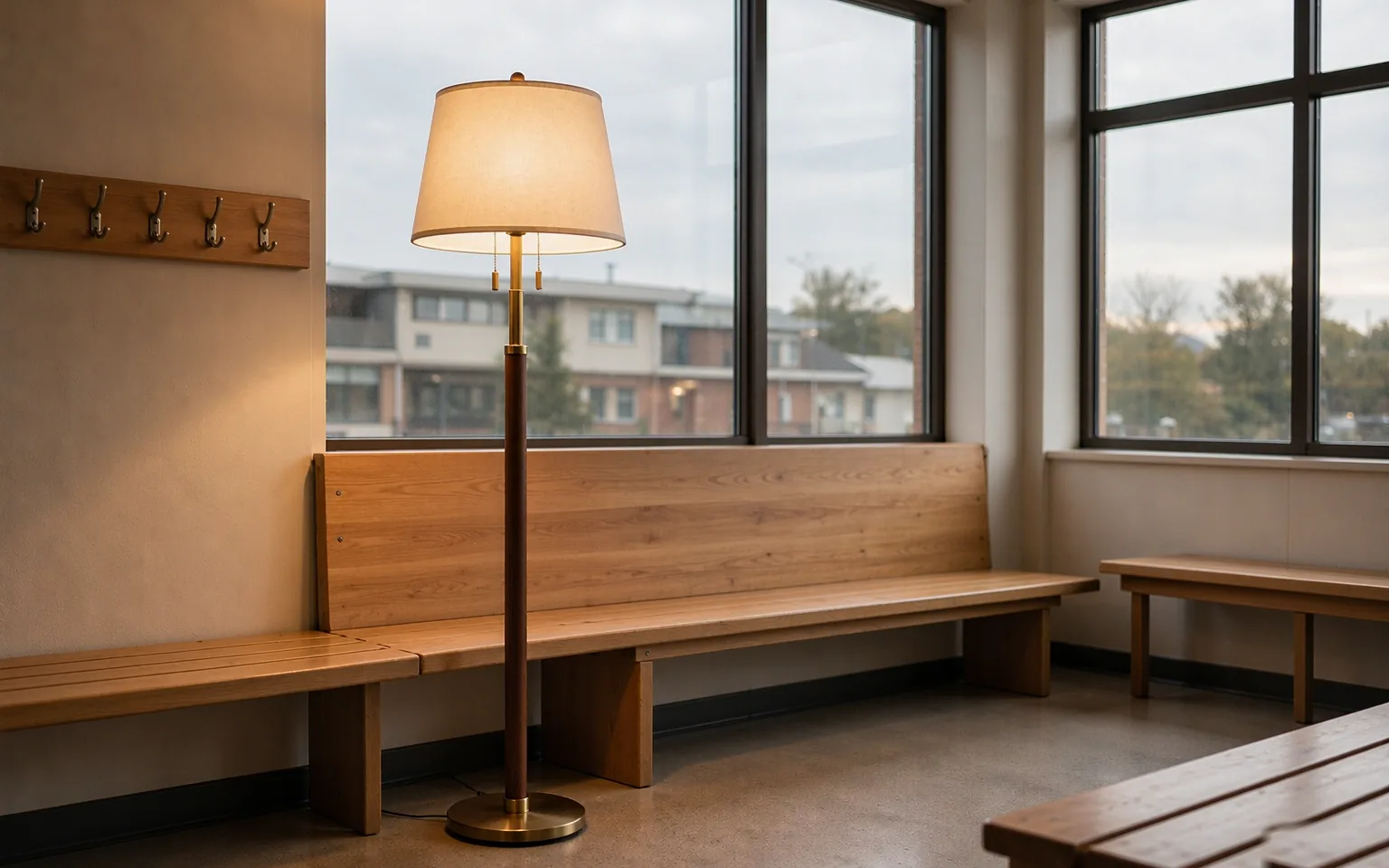
Amenity spaces get the design attention, but the lamps that quietly decide maintenance budgets in multifamily buildings are the ones inside the units. Every turn — every move-out and make-ready — a portable lamp is either wiped down and kept, or carried to the dumpster and replaced. Multiply that by the number of units and turns per year and the specification question becomes an operations question: which lamps survive a decade of tenants, and what does the maintenance team actually need from the ones you buy? For the shared spaces side of the building, see our guide to amenity lighting.
What the make-ready crew inherits
The lamp that comes back at turn is not the lamp that was installed. Shades are dented, harps bent, cords vacuumed into and occasionally cut by the vacuum itself, switch mechanisms sticky from kitchen film, bases wobbling from a stripped thread someone over-tightened in a hurry. The crew's decision is time-based: if a lamp can be brought back in under a minute — new bulb, wipe down, re-seat the shade — it stays; anything longer is replaced from the storeroom.
- A switch that survives film and grease — rotary or knob controls clean up better than touch sensors
- Shades that are standard sizes, so a replacement is a shelf item rather than a special order
- E26 sockets that take any commonly available bulb — no proprietary lamp requirements
- Bases that disassemble into a few sturdy parts for storage and moving
- Neutral finishes that do not date with unit refresh cycles
Standardise the fleet, not the decor
The strongest maintenance teams run a lamp fleet the way fleets are run: a small number of approved models, held in storeroom quantity, in finishes that work across unit palettes. Standardisation turns replacement into a parts decision and lets a property negotiate supply once instead of sourcing ad hoc at every turn. It also makes the bulbs simple — when every lamp in the portfolio takes the same E26 LED, the storeroom carries one bulb, and the make-ready checklist has one line where others have five.
In a thousand-unit portfolio, the lamp spec is not a design decision. It is a recurring line in the maintenance budget wearing a design decision's clothes.
Cords, bulbs and the storeroom shelf
Two consumables decide most of the make-ready lamp experience, and both are storeroom items rather than specification items. Cords fail at the plug and at the strain relief; a fleet spec that favours a replaceable cord set over a moulded-in one turns a common fault into a five-minute swap. Bulbs fail on schedule everywhere, which is why the one-bulb-fleet policy matters more than any individual bulb choice — the storeroom buys in bulk, the make-ready checklist never branches, and the unit the next tenant tours is lit consistently with every other unit in the portfolio.
The shelf itself deserves a place in the spec conversation. Lamps that nest — poles that telescope, shades that stack, bases that box flat — take a fraction of the storeroom volume of designs that ship assembled, and the difference compounds across a portfolio's turnover. Ask the supplier which models disassemble into few parts without tools; the answer predicts both the storeroom footprint and the moving-day experience every time a unit is refreshed.
Where floor lamps earn their keep
Units without ceiling fixtures in living areas — common in older stock — lean on floor lamps as primary ambient light, so the floor lamp is the workhorse of the fleet. Weight matters: a base heavy enough to resist an enthusiastic vacuum cleaner saves more replacements than any styling choice. Height matters too, because a floor lamp that reads a room helps the listing photos and the tour, which are marketing assets the turns exist to protect.
Ask the supplier which models are stocked domestically and can be replenished in small mixed quantities — storeroom restocking works best when the minimum is ten units across models, not per model.
Frequently asked questions
Should owner-supplied lamps be included in the lease inventory?
Most operators either fix them in the inventory list or treat them as property-maintained items excluded from tenant alteration clauses. Whichever route, document it — the disputes at move-out are almost always about items nobody listed.
Are two-pack table lamps worth standardising on?
Yes, wherever bedside pairs are the norm. A two-pack SKU halves the picking at turn and keeps the pair matching across years, which matters more in a rental than a design statement.
What bulb policy keeps make-ready simple?
One LED specification across the fleet — a warm colour temperature, a defined lumen band — stored in bulk. Non-standard bulbs fail the test the first time a storeroom runs dry on a weekend turn.
How should a lamp fleet be budgeted at scale?
As a maintenance line, not a capital line. Track replacements per hundred turns per model for a season and the numbers will tell you which spec choices — switch type, shade size, base weight — are actually paying for themselves, which is a firmer basis for the next fleet order than any catalogue claim.
Sourcing lamps for your business?
We stock the Anrotix range in the United States — complete with LED bulbs and accessories — and supply from 10 units, mixed across SKUs.
Request wholesale pricingRelated product: 69-Inch Wood Torchiere Floor Lamp — the primary-light workhorse profile that unit-turn programs standardise on
Recruiting regional partners worldwide — help@anrotix.cn