Last reviewed: Sep 15, 2026
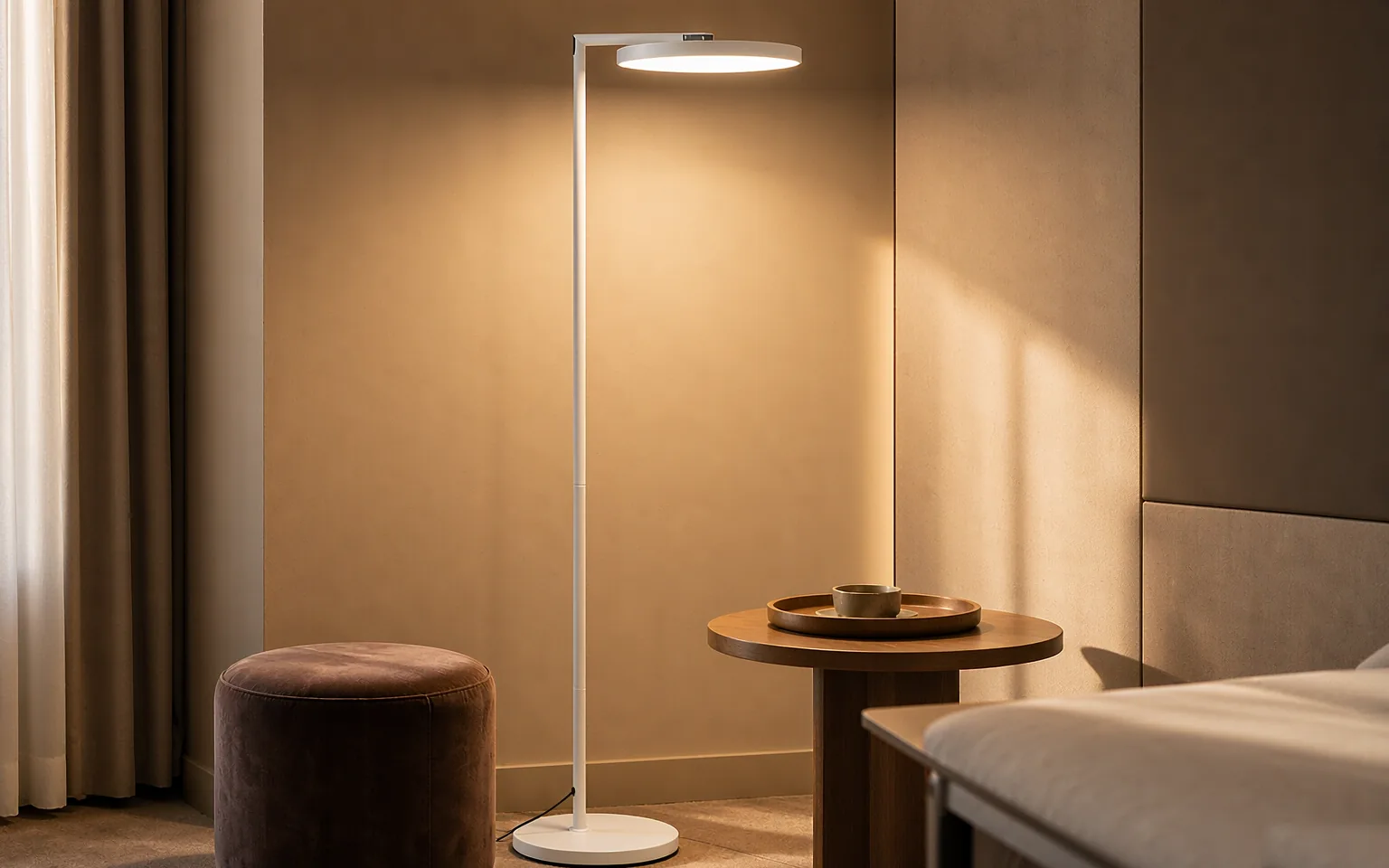
A vacation rental is harder on a lamp than a hotel room is. The guest turnover is faster, the cleaning is done to a schedule rather than a standard, nobody is on site to notice a wobble developing, and every lamp is photographed by someone trying to make the room look good enough to book. That combination produces a specification that is genuinely different from both a hotel and a home: it has to survive rough handling, it has to be replaceable by a host who is not a technician, and it has to photograph warmly. This article sets out how to specify lighting for short-stay properties, and why the choices that matter are not the ones that show up in the listing photographs.
The turnover test
In a hotel, a lamp is moved by housekeeping staff who do the same rooms repeatedly and report problems. In a short-stay property, it is moved by a cleaner working to a clock, by guests who rearrange furniture, and occasionally by a guest who decides the lamp would look better on the other side of the room. Multiply that by a changeover every two or three nights and the mechanical demands become clear.
Specify accordingly: a base heavy enough to stay put when someone drags it, a shade that can be straightened rather than replaced, and a switch that survives being operated by a guest who is looking for the light in an unfamiliar room at night. The stability questions are the same ones covered in tip-over and cord safety, and they matter more here than anywhere else in hospitality.
Photographing warm, and why it is a specification
The listing photographs are the product. A room that photographs cold gets fewer bookings regardless of how it feels in person, and the single biggest variable is colour temperature. Warm light in the living and sleeping areas is what makes a rental read as comfortable on a phone screen; cooler light tends to read as institutional.
That is a purchasing decision, not a decorating one: specify the colour temperature of the bulb the lamp ships with, and keep it consistent across the property. Mixed colour temperatures within one room is the most common lighting fault in rental photography, and it is caused by lamps bought at different times rather than by bad taste. The reasoning is set out in choosing colour temperature for North American interiors.
Consistency beats perfection. A property where every lamp is the same warm colour temperature photographs better than one with a perfect lamp in the living room and a different one in the bedroom.
Buy for replacement, not for repair
A host does not have a maintenance department. When a lamp fails between guests, the realistic options are to replace it immediately or to leave the room short of a lamp for the next arrival — and the second option produces a review mentioning the lighting. So the specification should prioritise units that can be swapped quickly with no tools and no technical knowledge.
- Standard E26 sockets and widely available bulb types, so a replacement can be bought locally at short notice
- Assembly that one person can do in minutes without instructions, because the original box will not be kept
- A finish that does not show fingerprints or water marks after a fast clean
- Shades that can be dusted rather than laundered
- A stable base that does not need levelling on a hard floor or a rug
- Packaging that survives being stored in a garage or a cupboard between seasons
Where to put the light, and how much
Rentals are usually under-lit in the corners and over-lit in the middle. The pattern that works is a layer per activity: ambient light for the room as a whole, task light where someone will actually read or work, and a bedside light that can be operated without getting up. That structure is described in three layers of light, and it is worth following in a rental because guests use rooms differently from the way owners do.
Give particular attention to the bedside. Guests charge phones, read in bed, and look for a switch in the dark, which is exactly why bedside lamps with integrated charging have become standard in serviced accommodation — the reasoning is the same as in extended-stay and serviced apartments.
Furnishing several properties at once
Hosts with more than one property have an advantage worth exploiting: standardisation. Buying the same two or three models across a small portfolio makes replacement trivial, makes the photography consistent, and means a spare lamp in the cupboard fits any unit. It also makes the reorder small and predictable rather than a periodic refurnishing project.
This is where a low minimum helps. A supplier who will ship a mixed order from ten units lets a host top up across the portfolio as things break, rather than waiting until enough has failed to justify an order.
What to check on arrival
Do the arrival check that a hotel would do and a host often skips: unbox, assemble, switch on, and look at the lamp under the room's own lighting at night rather than in daylight. Photograph the assembled lamp in situ, because that photograph is both your listing asset and your condition record. Keep the carton for a few weeks in case a unit needs to go back.
If you are furnishing or refreshing a short-stay property and want a range specified for exactly this use, send the room count and the mix you need to help@anrotix.cn or use the enquiry form; orders ship from ten units and can be mixed across models.
Buy one spare of each model you standardise on. In short-stay accommodation, the cost of the spare is small next to the cost of a room that photographs badly for a week.
Frequently asked questions
What colour temperature works best in a rental?
Warm light for living and sleeping areas, consistently applied across the property. The specific figure matters less than the consistency: mixed temperatures in one room is the fault guests and cameras both notice.
Should rentals use floor lamps or table lamps?
Both, and for different reasons. Floor lamps solve the problem of a room with no ceiling fixture and no bedside table; table lamps with charging solve the bedside problem. Most properties need a mix rather than one type.
How many lamps does a one-bedroom rental need?
Enough for one per activity rather than one per room: ambient light in the living area, a task light for reading or working, and a bedside light on each side of the bed. Under-supplying the bedside is the most common gap.
Sourcing lamps for your business?
We stock the Anrotix range in the United States — complete with LED bulbs and accessories — and supply from 10 units, mixed across SKUs.
Request wholesale pricingRelated product: Wood LED Table Lamp with USB-A, USB-C and an AC Outlet — a bedside unit that answers the charging expectation guests now arrive with
Recruiting regional partners worldwide — help@anrotix.cn