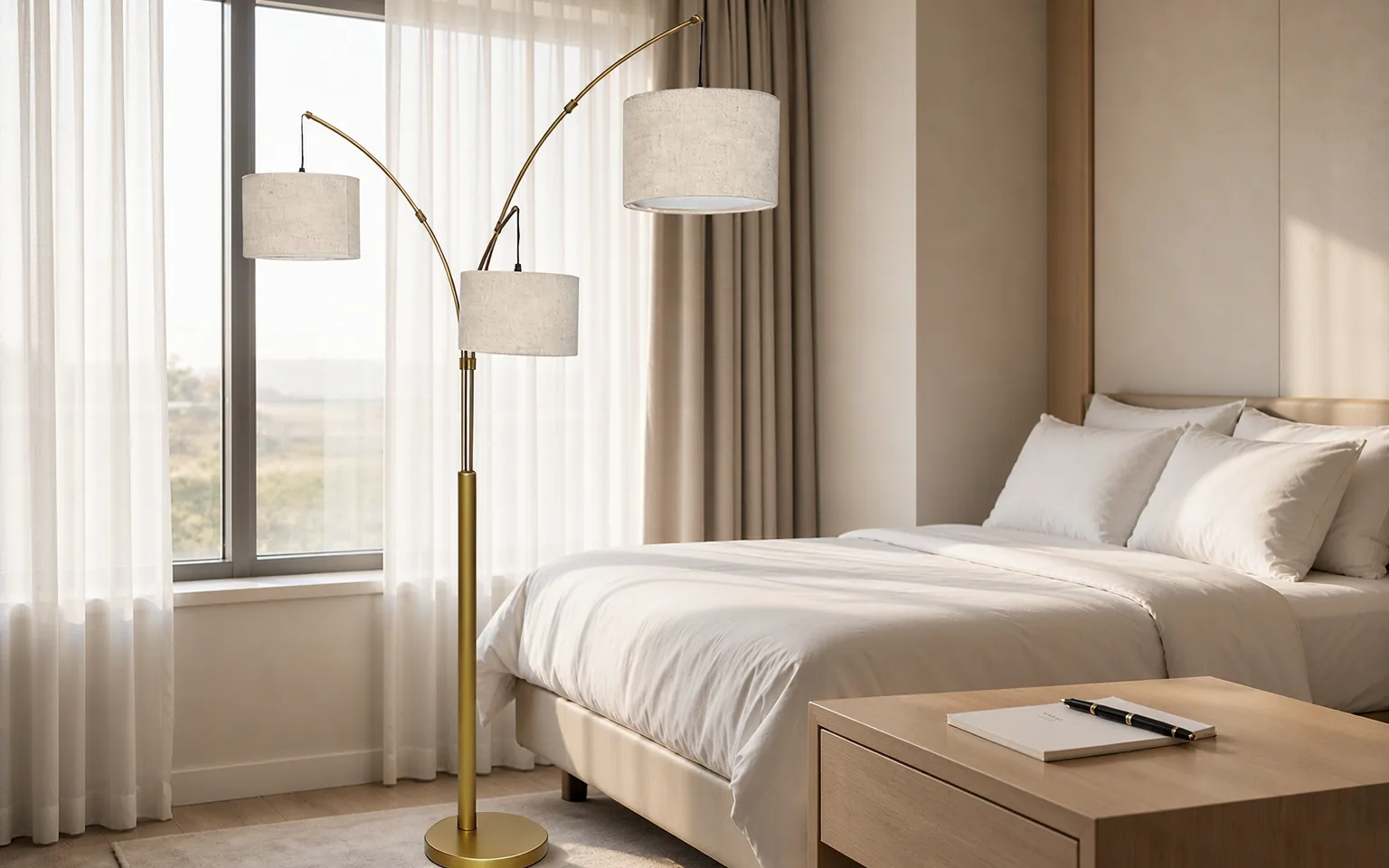
A specification can be perfect on paper and still fail in a mock-up room. That is the point of building one. The mock-up is where a brand representative, a designer and an operations manager stand in a real room with real lamps, turn them on and off, sit on the bed, and find the things nobody predicted. Lamps fail mock-ups more often than their cost would suggest, because a lamp is the one item in the room a guest touches every day.
Who walks the room, and what each of them is looking for
The designer is looking at whether the room reads the way the render did. The brand representative is checking against the standards document. The operations or housekeeping lead is asking whether the thing can be cleaned, relamped and survived.
Those three sets of eyes rarely agree on the first pass, and the lamp is where the disagreement usually surfaces. A designer wants a certain shade; housekeeping wants a shade that can be dusted without being deformed; the brand wants a switch a guest can find in the dark.
Knowing who will be in the room is half the preparation. The other half is knowing which of their objections is negotiable.
What actually gets changed after a mock-up
None of these is a defect. They are the reasons the room was built. What costs money is discovering them after the purchase order rather than before.
- Shade: the diameter or the opacity is adjusted because the light lands on a pillow instead of a book.
- Height: the bottom of the shade is moved relative to the mattress or the seating.
- Switch position: the control is moved because a guest cannot reach it from the bed or the chair.
- Finish: the metal reads warmer or cooler against the actual wallcovering than it did against a sample chip.
- Cord route: the cord is visible where the drawing assumed it would not be.
- Bulb: the included lamp is too cool, too dim, or both.
The lamp-specific checks worth running in the room
Turn every lamp on and off from the position a guest would actually be in — lying in bed, sitting in the chair, standing at the desk. A switch that requires leaning behind a headboard will be reported by guests within a week of opening.
Check the light on surfaces people use. Guest Room Light Levels: A Specification You Can Defend covers how to think about levels without turning the conversation into a photometry argument.
Shake the floor lamp gently. A base that is fine on a drawing can be marginal on thick carpet with a deep pad, and this is the moment to find that out rather than after installation.
Prepare the submission as if nobody will read the drawing
Bring a labelled physical sample of every lamp in the schedule, assembled, with the specified bulb installed. Bring a printed specification sheet for each, and the compliance documentation for the specific model rather than for the range in general.
Bring a spare. Something gets dropped, and a second unit turns a two-week delay into a non-event. The Sample Round: How to Order, Evaluate and Sign Off a Lamp Before Volume covers the mechanics of getting samples approved in a way that survives contact with the volume order.
Photograph the room with each lamp lit on its own and all lamps lit together. The photographs become the reference when the volume shipment arrives and somebody asks whether it matches.
Time the mock-up before the specification is frozen, not after
The most expensive mock-up is the one that happens after the purchase order is placed, because every change becomes a change order. Build the mock-up early enough that a shade swap is a line edit rather than a renegotiation.
Where a property is part of a larger rollout, the mock-up room is effectively the prototype for every property that follows. Rolling One Lamp Specification Out Across Twenty Properties explains why the extra two weeks spent here usually pay for themselves many times over.
If the programme is on a hard opening date, agree in advance which changes are acceptable without reopening the schedule, and put that in writing.
Common ways a lamp fails a mock-up for non-visual reasons
These are operations failures, not design failures, which is why the operations lead needs to be in the room and not reading the minutes afterwards.
- The switch is a type housekeeping cannot operate quickly with a gloved hand.
- The shade shape collects dust in a way that shows under the room's own lighting.
- The base marks a carpet or a wood floor when the lamp is moved for cleaning.
- The cord is too short for the outlet position in that specific floor plan.
- The bulb is not a stock item the property's maintenance team already buys.
Turning the outcome into a document
When the room is approved, write down exactly what was approved: model, finish, shade, bulb, switch type and any agreed changes. Attach the photographs. Circulate it to the designer, the purchasing agent and the supplier.
That single document prevents most of the disputes that otherwise arise at delivery, because the question at that point is never 'is this nice' but 'is this what was approved'. Without it, the same conversation happens again with several hundred cartons on a dock.
Confirm the approved bulb is the bulb that ships with the volume order. It is a small line and a frequent mismatch.
Where Anrotix fits
For mock-up and sample rooms, Anrotix supplies from US stock: nine 120V floor and table lamp models, orderable from ten units with mixed SKUs, dispatched within one business day. That makes it practical to order the two or three candidates side by side rather than committing to one on a drawing.
The Anrotix portable-luminaire range is ETL listed to UL 153 and CSA C22.2; certificate copies and confirmation of which models the listing covers are provided on request. Wholesale pricing is quoted by tier rather than published — send the model list and quantity with an enquiry for a tiered quote.
For samples for a mock-up room, email help@anrotix.cn with the floor plan, the outlet positions and the ceiling height. We will tell you which models are worth putting in the room.
Related reading
- Hotel Floor Lamps: Designing for Ten Thousand Switches
- The Sample Round: How to Order, Evaluate and Sign Off a Lamp Before Volume
- Writing an FF&E Lamp Specification Package: What Belongs in the Document
Frequently asked questions
When should a mock-up room be built?
Before the lamp specification is frozen and before the purchase order is placed. A mock-up that happens after the order turns every change into a change order.
Who should attend the mock-up walk-through?
The designer, the brand or owner representative, and someone from operations or housekeeping. Lamps fail mock-ups on operational grounds more often than on visual ones.
What should be recorded after approval?
Model, finish, shade, bulb, switch type, any agreed changes, and photographs of the room lit. Circulate it to everyone who will be at the delivery.
Sourcing lamps for your business?
We stock the Anrotix range in the United States — complete with LED bulbs and accessories — and supply from 10 units, mixed across SKUs.
Request wholesale pricingRelated product: bedside table lamp with USB charging — the kind of model that gets changed after a mock-up walk-through
Recruiting regional partners worldwide — help@anrotix.cn