Last reviewed: Sep 15, 2026
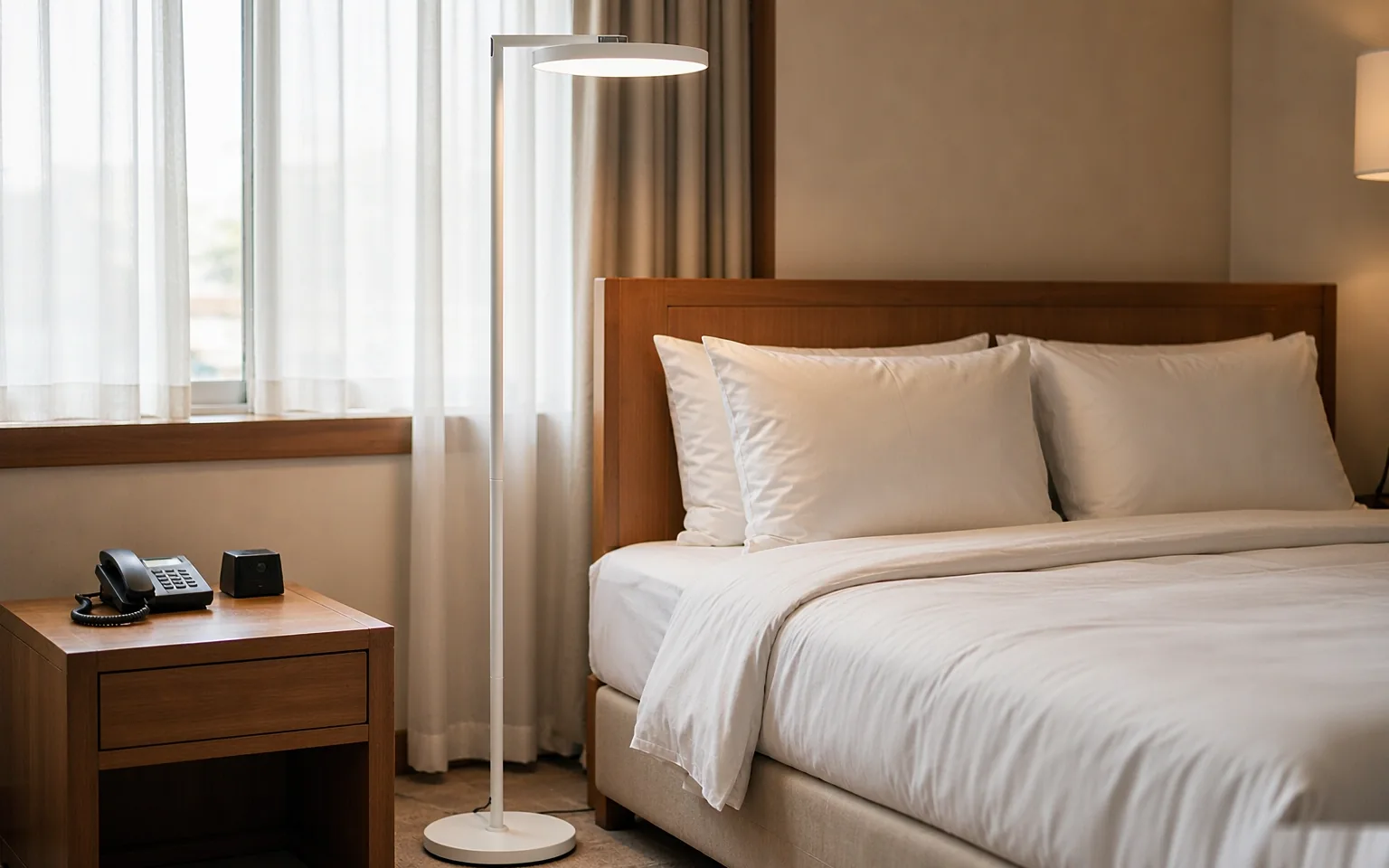
Hospitality lighting fails on the components a residential buyer never thinks about: the switch, the joint and the cord. Modelling the usage changes the entire specification conversation.
Do the arithmetic
A home lamp might be switched twice a day, which is roughly seven hundred operations a year. A guest room lamp in a property with eighty percent occupancy is switched four to six times a day per room, and the switch is also operated by housekeeping. Over five years, that is tens of thousands of cycles on a component that was probably qualified for far fewer.
| Component | Residential expectation | Hospitality requirement |
|---|---|---|
| Switch | Occasional use | Rated for high cycles, accessible, replaceable |
| Joints | Set once | Friction held, or lockable, with no drift |
| Cord | Runs along a wall | Routed and secured, never in a walkway |
| Shade | Fabric is fine | Wipeable, no-fade, no adhesive seam |
| Base | Stable | Heavy enough for cleaning staff and carts |
Cords and trip hazards
A cord that reaches across a guest room floor is a liability claim and a housekeeping problem. Specify cord length, exit position and any over-moulded strain relief, and expect a keeper or clip to be part of the design rather than an afterthought.
Control logic for guests
Guests do not read instructions. A lamp that requires a sequence, a remote that cannot be found, or a touch control that responds unpredictably will generate maintenance calls. A single rotary or rocker switch that does what it looks like it does is the correct answer for most properties.
Maintainability is a purchasing decision
Ask three questions before ordering: can the switch be replaced without replacing the lamp, is the cord set available as a spare part, and is the shade supplied separately. A property with fifty guest rooms will need all three within three years. For torchiere models add a fourth — can the uplight head be ordered on its own — because the head is the part guests lean on and the part housekeeping ladders clip, and replacing a head beats replacing a seventy-six-inch lamp every time it happens.
Light quality in a guest room
Warm, dimmable and layered. Guests using a lamp as a reading light and as a night light will push whatever control exists to both extremes, which is why a smooth dimming range down to below five percent matters more here than peak output.
Related reading
Frequently asked questions
What makes a floor lamp durable enough for hotels
Hotel use means frequent moves, cleaner access, and harder knocks than a home, so the base, joint, and cord need to survive handling. A stable base, secure connections, and a finish that resists cleaning chemicals reduce in-room failures.
Should hotel lamps be listed to the same standard as retail
Yes. For North America the portable lamp should still be ETL or UL listed to UL 153, with CSA C22.2 for Canada; contract use does not relax the safety requirement. Confirm the listed model is the one specified for the property.
What should I ask a supplier about contract durability
Ask for the base construction, cord rating, and any drop or cycle testing done for hospitality, plus the warranty terms for commercial use. A supplier used to residential only may not have the build a hotel programme needs.
Sourcing lamps for your business?
We stock the Anrotix range in the United States — complete with LED bulbs and accessories — and supply from 10 units, mixed across SKUs.
Request wholesale pricingRelated product: Remote-controlled LED torchiere — a remote model specified for repeated daily use
Recruiting regional partners worldwide — help@anrotix.cn