Last reviewed: Sep 15, 2026
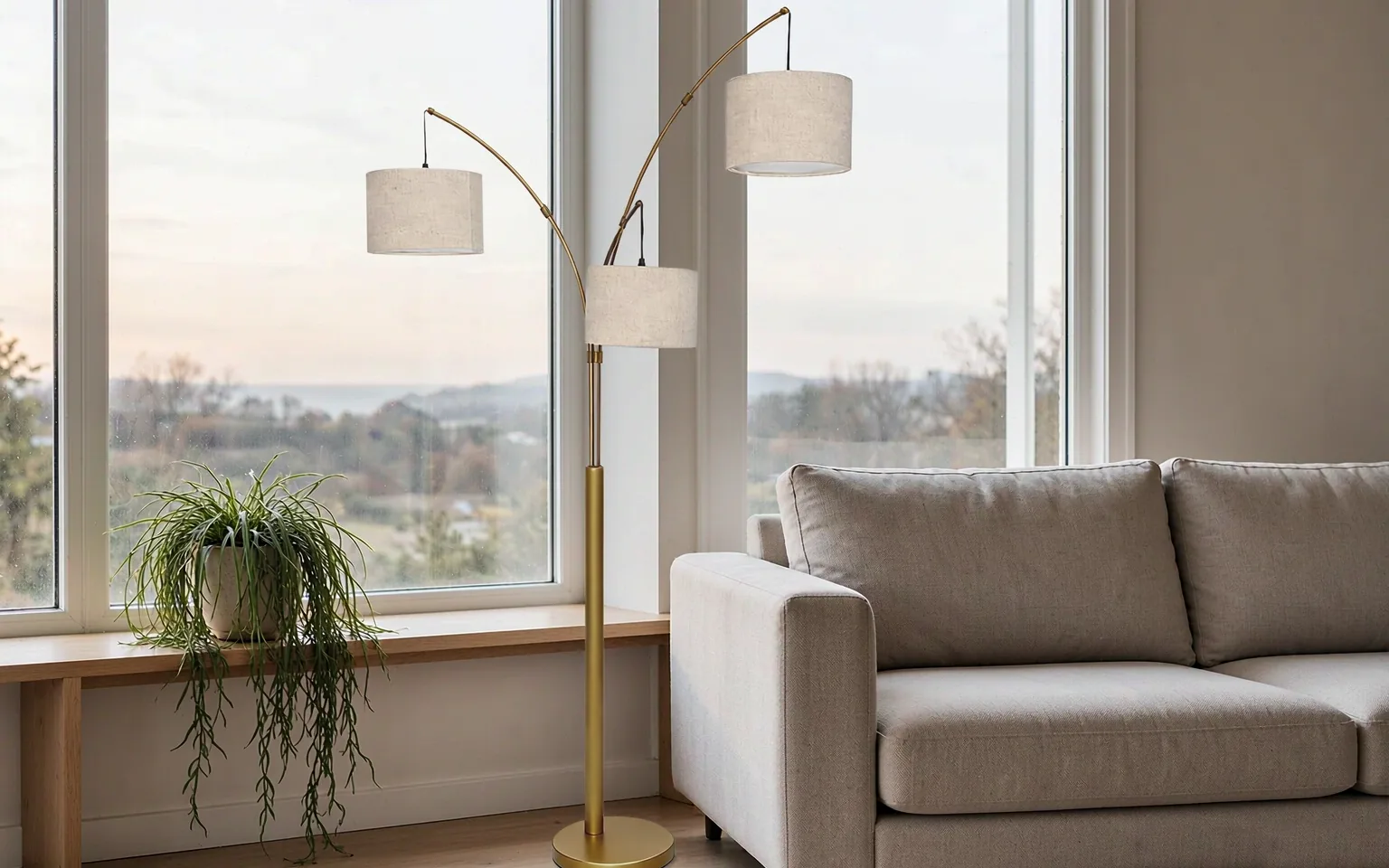
Buyers compare lamps by base, height and finish, and then act surprised when two similar-looking lamps light rooms completely differently. The shade shape is the quiet variable: it decides how much light leaves the top, how much spreads sideways, and where the pool of brightness lands. Since the shade, not the bulb, sets the character of the light — the argument our shades decide the light guide makes in full — shape selection is one of the few decisions in a lamp programme that changes the product's behaviour in every room it enters.
The drum: even, modern and honest
The cylindrical drum shade is the workhorse of contemporary interiors. With vertical sides of roughly equal diameter top and bottom, it emits light fairly evenly upward and outward, giving a room a clean wash of ambient light with a soft, symmetric look. Drums suit spaces that need general brightness more than drama: living rooms, hotel lounges, model units.
The trade-offs are predictable. The equal top opening means more light escapes upward, which is generous for ambient purposes but less efficient for task light below. Drum shades also expose more of the bulb's brightness to a seated eye at certain angles, so the inner diffuser quality matters — a point our shades and diffusers buying guide covers in detail.
The empire: directional and efficient
The tapered empire shape — narrower at top, wider at bottom — is the traditionalist of the family, and the geometry gives it a purpose. The wide bottom opening throws light down and outward in a defined pool, while the narrow top restrains upward spill. For reading positions, bedside lamps and any fixture whose job is to put light where people are, the empire profile earns its ubiquity.
Empire shades also flatter the lamp itself: the taper reads as elegant from most angles and visually shortens very tall lamps, one reason floor lamps so often wear them. The cost is symmetry of ambience — rooms lit only by empires can feel pooly, with bright islands and dim corners. Our floor lamp placement mistakes guide is partly a guide to compensating for exactly that.
The bell and the soft classics
Bell shades — curved sides swelling outward — sit between the two philosophies. The curve directs a good portion of light downward like an empire while the softer silhouette scatters more at the edges, giving gentler transitions between light and dark. Bells dominate traditional and transitional interiors because they photograph warmly and flatter almost any base style.
The practical caution is proportion. Bells and other curvy shapes are less forgiving of mismatched proportions than drums are; a bell too squat or too tall for its base reads wrong in a way straight-sided shades do not. Buyers assembling a programme should check each model's shade-to-base proportion as a photographed unit, not a spec-sheet ratio.
What shape means for a programme
Assortment logic follows from the physics. A programme built entirely of drums will light rooms evenly but identically; one built entirely of empires will read as traditional and pool-heavy. Mixing shapes across a range lets a retailer cover moods — a price ladder and assortment guide pairs naturally with a shape story — and lets a hotel specify a consistent family that still varies by space.
Shape also interacts with colour temperature choices: the same warm bulb reads cosier through a bell, crisper through a drum. And whatever the shape, the fitting system decides whether the shade can even be swapped later — our shade fitter types guide explains the hardware, which matters more than buyers expect when a programme needs updating without replacing lamps.
Testing shape before committing volume
Shape decisions survive contact with real rooms better than paper: order the sample, place it where the room's eye level actually is — seated, not standing — and look at both the light pattern on the walls and the shade's appearance from the doorway. A shape that looks balanced on a spec sheet can dominate a small room or vanish in a tall one.
Anrotix keeps shade philosophy practical across the range: our portable-luminaire collection is built to ETL listed to UL 153 and CSA C22.2, with shade choices specified per model and stated plainly in our floor and table lamp comparison. If you are building an assortment and want to talk through which shapes cover your channels, write to help@anrotix.cn — we will match models to the light character you are after.
Frequently asked questions
Which shade shape gives the most ambient light?
Drums. Their vertical sides throw light evenly up and out, giving the most uniform room wash. Tapered shapes like empires direct more light downward, which is better for tasks and pools of light but less even as ambience.
Are empire shades only for traditional interiors?
No — the taper is a light-distribution tool, not just a style. Empires appear in modern designs wherever directional light matters, such as reading lamps. The styling range is wider than the shape's traditional reputation suggests.
Can shade shapes be swapped on the same lamp?
Often, depending on the fitter system and the harp size. The fitting hardware decides compatibility, so check the fitter type before planning shade swaps — some lamps accept a range of shapes, others are effectively fixed.
Sourcing lamps for your business?
We stock the Anrotix range in the United States — complete with LED bulbs and accessories — and supply from 10 units, mixed across SKUs.
Request wholesale pricingRelated product: the three-head arc floor lamp — three matched linen shades — a working example of shape consistency across a lamp
Recruiting regional partners worldwide — help@anrotix.cn