Last reviewed: Sep 15, 2026
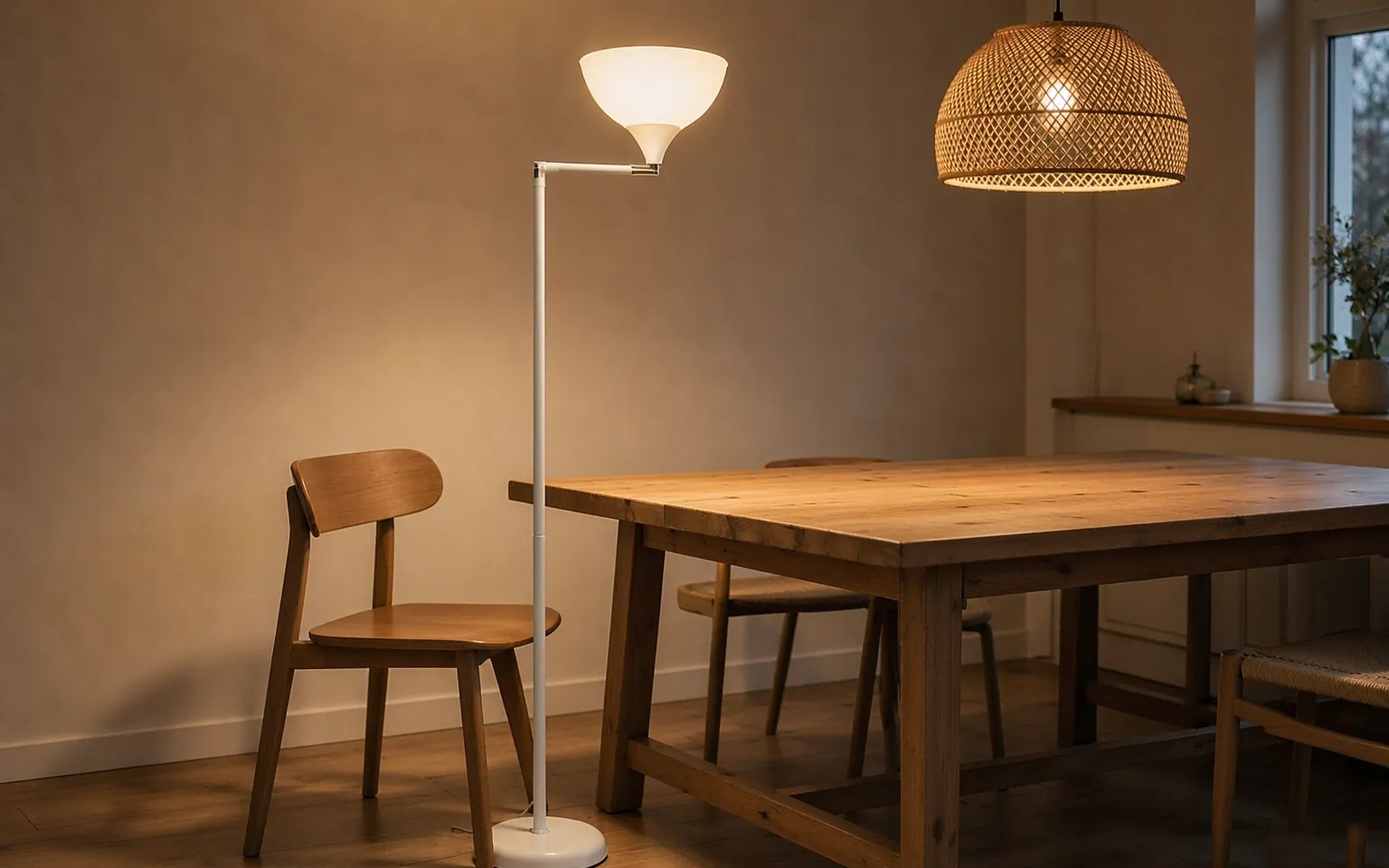
Bulbs are advertised and shades are chosen for looks, which is roughly backwards. A shade decides how much light escapes, in which direction, and whether the lamp is comfortable to sit next to.
Three properties of every shade
Material, opacity and geometry. Material controls colour tint. Opacity controls how much light comes through the side walls. Geometry controls the spread of the light leaving the top and bottom openings.
Direction: the top and bottom openings do the work
A drum shade with open ends sends most of its useful light up and down. A shade with a closed top throws everything downward. A diffuser at the bottom softens the pool of light on the table, which is why so many hospitality lamps use one.
| Shade | Light direction | Best for |
|---|---|---|
| Open drum | Up and down | Ambient plus a usable pool below |
| Closed top | Down only | Reading, task, no ceiling wash |
| Linen or cotton | Through the walls too | Warm, soft, low contrast |
| Metal or opaque | Openings only | Directional accent |
| Glass or acrylic diffuser | Diffused, wide | Even, glare-free, hospitality safe |
Opacity and glare
A shade that transmits light through its walls cannot hide the bulb. If a customer can see the filament through the fabric from a seated position, the lamp will be described as glaring no matter how good the bulb is.
Colour tint changes the finished lamp
A cream linen shade over a 2700K bulb reads warmer than the bulb alone. A grey linen shade pulls it cooler. When a customer asks for a warm lamp, the shade is often the cheaper place to solve it.
Shipping and shape
Wide shades cost more to pack, and they are the part most likely to arrive dented. A shade with a slight taper is easier to protect than a wide cylinder of the same diameter, which is a packaging decision made at the design stage rather than the warehouse.
Related reading
- Uplights Depend on Your Ceiling More Than Your Bulb
- Three Layers of Light, and Why One Fixture Cannot Do All Three
Frequently asked questions
How does a lamp shade change the light?
The shade material and liner control spread and glare. An opaque or dark shade throws light up and down; a light or linen shade softens and diffuses it. The shade is as important as the bulb.
What shade gives the least glare?
A shade with a white or cream liner and enough depth to hide the bulb from eye level. Avoid very short shades with clear or thin fabric, which expose the source.
Does shade colour affect brightness?
Yes. Lighter liners reflect more light into the room; darker liners absorb it and create a more moody pool. Pick liner colour by the ambience you want, then match the bulb's lumens.
Sourcing lamps for your business?
We stock the Anrotix range in the United States — complete with LED bulbs and accessories — and supply from 10 units, mixed across SKUs.
Request wholesale pricingRelated product: 3-light arc floor lamp — three linen shades over one frame, where the shade does most of the work
Recruiting regional partners worldwide — help@anrotix.cn