Last reviewed: Sep 15, 2026
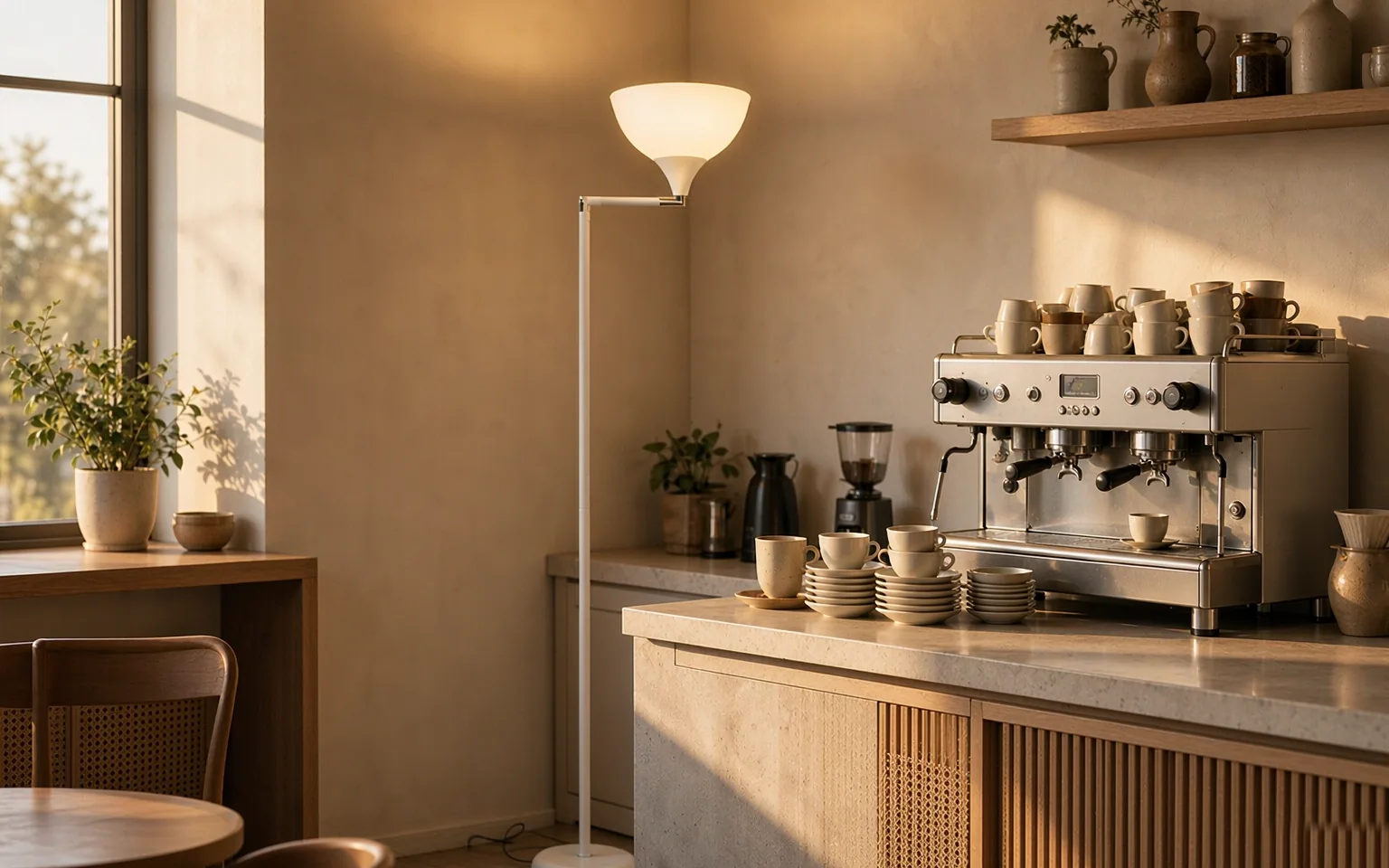
Every hotel project reaches the point where the FF&E schedule is over budget and something has to come out. Lighting is a tempting target because it looks like a commodity and because the savings look large on a spreadsheet. The projects that come out of that exercise with the room still intact are the ones that decide in advance which variables are negotiable and which are not.
Why lighting gets picked on
Lighting is specified late relative to case goods, it is usually a smaller line than the furniture package, and it is easy to describe imprecisely. A schedule item that says floor lamp, metal, black can be satisfied by dozens of products at wildly different price points, and the schedule will still technically be met.
That imprecision is the actual problem. When the specification is loose, value engineering happens by substitution, and substitution is where the design intent dies. When the specification is tight, value engineering happens by variable, and the room survives.
The distinction is worth internalising before the budget meeting rather than during it.
The variables, ranked by how much damage they do
Work down that list rather than up it. Value engineering that starts at the finish and works up to the light output only if it must is value engineering that mostly works.
- Light output and distribution: change this and the room changes. A lamp that produces the same lumens through a different shade geometry lights a different part of the room. Protect this first.
- Height and reach: these were chosen against a sofa, a chair or a bedside table. Reducing reach by a few inches moves the pool of light off the surface it was meant to serve.
- Colour temperature and colour rendering: guests do not name these, but they read a warm, low-CRI room as cheap. This is a common silent casualty of substitution.
- Control type: a switch position that made sense in a mock-up can become a daily frustration at volume. It is also one of the few variables that is genuinely cheap to get right.
- Finish: usually the least damaging variable, provided the replacement finish is stable across batches and matches the other metals in the room.
- Base and stem material: often negotiable, provided stability and the tip-over behaviour are not compromised.
The substitutions that reliably backfire
Swapping a three-light arc for a single-light arc saves money and removes the light the designer was relying on. The room still has a lamp in the corner; it no longer has light over the sofa.
Swapping a torchiere for a downlight shade saves money and changes the ceiling reflectance calculation. Uplight relies on the ceiling to do half the work, and a room with a dark or textured ceiling loses that half entirely.
Swapping to a lower shade density or a cheaper diffuser usually increases glare in the seated position. Nobody writes that down as a defect, but it is the sort of thing that shows up in guest comments as a room that felt harsh.
Swapping the included bulb to a cheaper one changes colour temperature and rendering at a stroke, and it is the single cheapest thing to protect. The Bulb in the Box: Choosing the Included LED That Your Lamps Ship With covers why that small line deserves a specification of its own.
Run the exercise on a real room, not on a schedule
The most reliable way to value engineer lighting is to put the candidate in the room it is meant for and look at it in the evening. The Sample Round: How to Order, Evaluate and Sign Off a Lamp Before Volume describes that round; the value engineering version of it is simply two samples instead of one, evaluated against the same surfaces at the same time of day.
If the schedule does not allow a second sample round, the next best protection is to write the non-negotiables into the specification explicitly. Guest Room Light Levels: A Specification You Can Defend shows how to express light requirements in a way a substitute product has to meet rather than merely resemble.
And remember that durability is a cost variable too. A lamp that is cheap to buy and expensive to keep in service is not a saving. Hotel Floor Lamps: Designing for Ten Thousand Switches sets out what to look for before a cheaper model enters a guest room.
For two sample units to compare against a value engineering decision, or for a tiered quote on the current range, email help@anrotix.cn with the room type, the ceiling height and the models being compared.
Frequently asked questions
What is the safest variable to change first?
Finish and base material, provided stability and batch-to-batch consistency hold. These change the look least in the evening and are the easiest to verify from a sample.
Is a lower-priced lamp of the same type a safe substitute?
Only if output, distribution, height and colour temperature match. Same type describes the shape, not the light. Ask for photometric or at minimum a like-for-like comparison in the actual room.
How do we stop substitution happening without our knowledge after handover?
Lock the specification to a named model and a named finish, and make the reorder path explicit. Most drift happens on replacement orders placed years later by someone who never saw the original specification.
Sourcing lamps for your business?
We stock the Anrotix range in the United States — complete with LED bulbs and accessories — and supply from 10 units, mixed across SKUs.
Request wholesale pricingRelated product: the nine-model range side by side — height, reach, socket, control type and finish across six floor lamps and three table lamps
Recruiting regional partners worldwide — help@anrotix.cn