Last reviewed: Sep 15, 2026
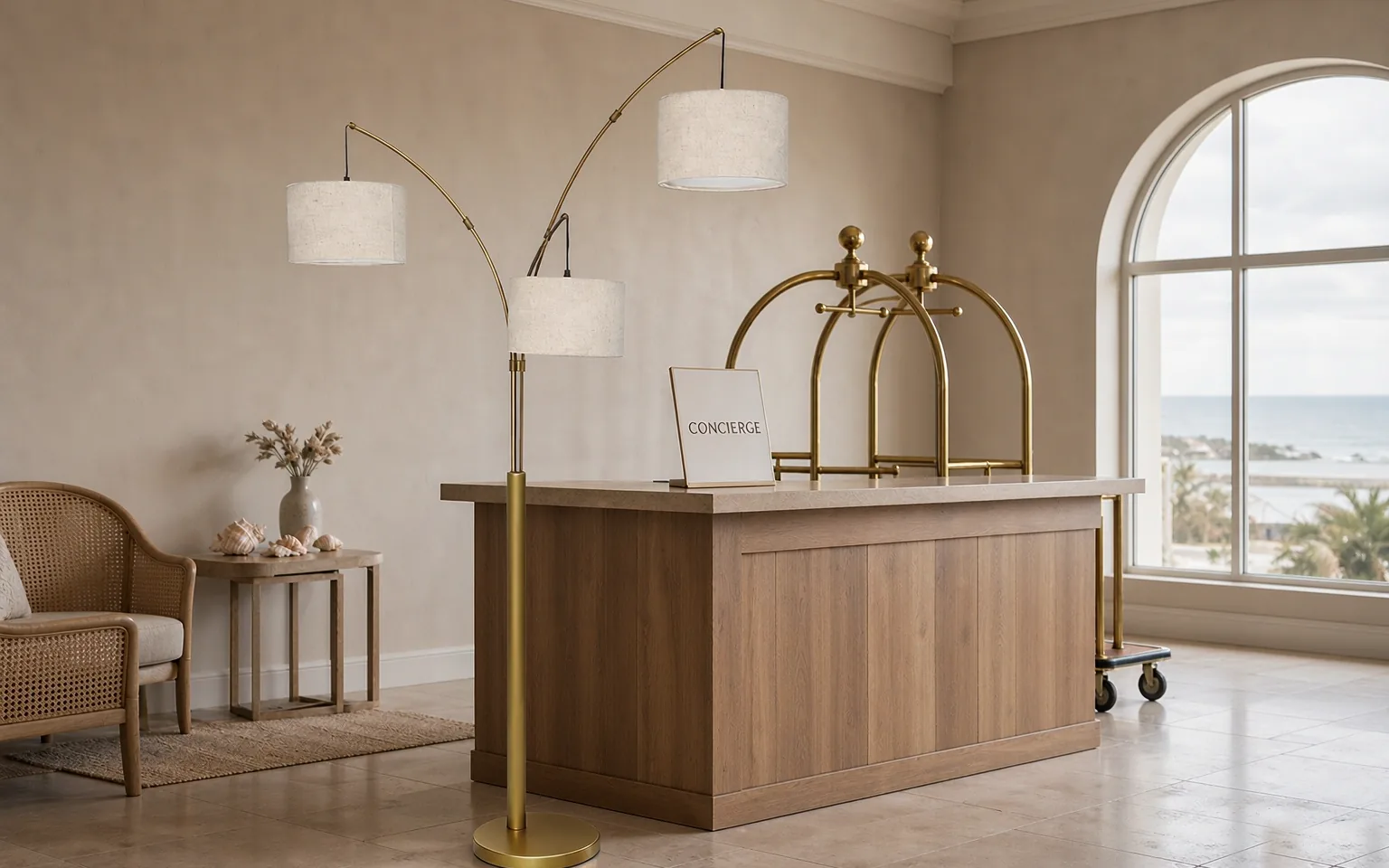
Guests form an opinion of a building in about thirty seconds, and lighting does most of the work in that half minute. It is also the part of the specification that gets reconsidered most rarely and regretted most often, because a lobby is lit for two contradictory purposes at once: it must feel welcoming at eight in the evening and it must let a receptionist read a document at eight in the morning. This article is about resolving that contradiction with portable luminaires — what to place, how bright, at what height, and how to spec a lobby that still looks right two years after handover.
Two jobs, one room
The mistake is treating a lobby as a single lighting problem. It is two: an ambient problem, which is about how the volume of the room feels, and a task problem, which is about the reception desk. They need different light at different levels, and the failure mode is almost always solving one and hoping it covers the other.
The structure that works is the same layered approach described in three layers of light: a general level that makes the space feel occupied and warm, a task level at the desk that is genuinely sufficient for reading and screen work, and an accent level that gives the eye somewhere to go. One luminaire type cannot do all three, and a lobby with only one layer always reads as either a waiting room or an office.
Height and the entrance sequence
Lobbies are frequently tall, and tall volumes punish low light sources: a lamp that works in a three-metre hotel corridor disappears in a six-metre atrium. The practical response is not to buy brighter lamps but to place light where people actually are — in the seating group, beside the desk, at the lift lobby — and to accept that the upper volume is architectural rather than lit by you.
Think about the sequence rather than the room. A guest moves from bright daylight outside, through a transition at the door, into the seating area. The transition is where eyes adjust, and it is worth giving that zone its own light rather than leaving it as the gap between the door and the first lamp. Our guide to floor lamp height gives the working heights for lamps beside seating, which is where most lobby lamps actually sit.
- Seating groups: light at the shoulder of a seated person, so a guest can read without leaning
- Reception desk: task light on the work surface, plus a warm ambient level so the desk does not read as a counter
- Entrance transition: enough light to feel safe and oriented, not enough to flatten the room
- Circulation routes: light that marks the path to the lifts or the corridor without lighting the ceiling
- Feature wall or artwork: a single accent, deliberately placed, rather than general brightness
Lobbies fail by being uniformly lit. The rooms people remember have a lit seating group and a darker perimeter, not even coverage from wall to wall.
Uplight, and whether your ceiling can take it
Torchieres are the natural lobby choice because they throw light upward and make a tall room feel occupied without glare at eye level. They are also the choice most dependent on something you may not control: the ceiling. A dark or textured ceiling absorbs the output and the lamp underperforms; a pale one returns it and the same lamp looks twice as effective.
This dependency is explained in uplights and ceiling reflectance, and it should be checked before specifying rather than discovered at handover. If the ceiling is dark, place more of the budget in shaded lamps that light the seating group directly and use the torchiere as filling rather than as the primary source.
Durability in a public room
A lobby lamp is public furniture. It is touched by every guest, moved by cleaners, knocked by luggage, and it is the first thing a tired traveller leans on. Specify a base that resists a nudge, a finish that survives repeated handling, and a cord route that does not cross a walking line. Cord management in a public room is a safety question rather than a tidiness one.
Where the space is used for amenity purposes as well as arrival — co-working by day, residents in the evening — the specification overlaps with amenity spaces in multifamily buildings, and the same durability logic applies.
Replacement and the spare-parts reality
Lobby lamps are visible failures. When one goes dark, it is noticed immediately by staff and guests, and it cannot be left for a week the way a failed lamp in a back corridor can. That argues for standardising on models that can be reordered quickly and replaced by one person, and for holding a spare on site.
Ask two questions before specifying: how quickly can a replacement arrive, and can it be the same model rather than a close match? A lobby with one mismatched lamp looks worse than a lobby with one lamp missing, and mismatches happen when the original model has been discontinued.
Specifying for handover, not for photography
Lobbies are photographed on the day they open and lived in for years afterwards. Specify for the second condition: choose a colour temperature the building will keep, confirm the bulbs are a type facilities can still buy in three years, and write the model codes into the handover document so the next buyer can match them.
For a lobby or reception refurbishment, send the room dimensions, ceiling finish and seating layout to help@anrotix.cn, or start from the wholesale enquiry page — a tiered quote is prepared against the models and quantities you actually need, and orders ship from ten units mixed across the range.
Write the model codes and bulb specification into the handover pack. The most common lobby lighting failure is not a failure at all — it is a replacement that nobody could match.
Frequently asked questions
How bright should a hotel lobby be?
Bright enough at the desk for documents and screens, and deliberately softer everywhere else. The contrast is what makes it feel like hospitality; uniform brightness is what makes it feel like an airport.
Are floor lamps appropriate in a large lobby?
Yes, when they are placed where people are — seating groups, desk flanks, lift waiting areas — rather than distributed evenly around the perimeter. In a very tall atrium, treat the upper volume as architectural and light the occupied zone.
Should the lobby lighting be dimmable?
Worth specifying where the room changes use between day and evening. Dimmability only helps if the control is somewhere staff will actually use it, so agree the control position at design stage.
Sourcing lamps for your business?
We stock the Anrotix range in the United States — complete with LED bulbs and accessories — and supply from 10 units, mixed across SKUs.
Request wholesale pricingRelated product: 69-Inch Wood Torchiere Floor Lamp — an uplight suited to seating groups, subject to the ceiling reflectance check described above
Recruiting regional partners worldwide — help@anrotix.cn