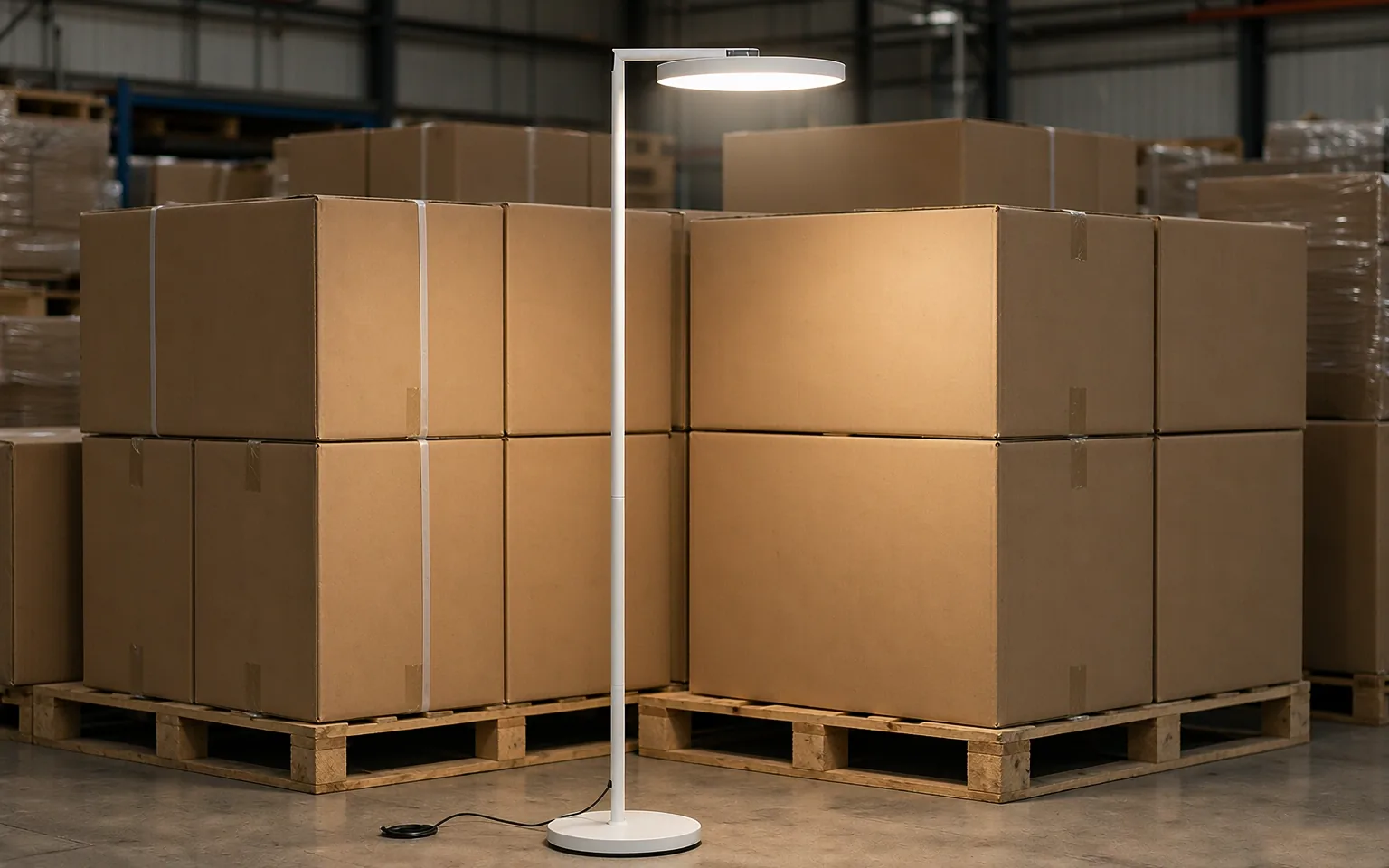
Most lamp cost engineering stops at the carton. The carton is where the obvious savings are, but the pallet is where the money actually leaks, because a tall, light, easily-crushed carton is the worst possible thing to stack. Get palletization wrong and you pay to ship air, or you pay to replace lamps crushed by their own neighbours.
Why lamps are a palletization problem
A lamp carton is long in one dimension and thin in the others, which means it either stands up (tall, tippy, hard to interlock) or lies down (stable but uses floor space a cube-efficient box would not). Neither default is great, and the right answer depends on the carton's actual dimensions, not a generic rule.
This is the warehouse-layer version of the container problem. Our Loading a Container of Lamps guide covers the ocean leg; palletization is the same maths at the distribution-centre scale, where you are paying local freight per cube.
Cube out before you weigh out
Lamp shipments almost always cube out — they fill the trailer by volume before they hit the weight limit. That makes carton dimensions the lever, not the carton weight. A few centimetres shaved off a carton's long side can mean one more layer per pallet and a meaningful drop in cost per lamp delivered.
The carton itself is where that starts. Our Carton Design: The Cheapest Place to Save article shows why dimensional weight, not scale weight, usually sets the bill — and palletization is where dimensional wins or losses are realised.
Protecting the load without over-packaging
Tall cartons stacked directly on each other transfer point loads straight down through the shade. Interlocking layers, edge protectors and the right stretch-wrap tension prevent the crushing that shows up as dented shades at goods-in — the failure mode our Preventing Transit Damage guide is written around.
The aim is a pallet that arrives intact and dense. A pallet that survives transit but ships half-empty is still losing money; a dense pallet that arrives crushed is losing the product. Both are design problems, not luck.
What Anrotix ships
We hold stock in the United States and release it in the quantities a distribution centre actually needs rather than forcing full-container maths onto a domestic move. Standard portable lamps are 120V with E26 bases and US plugs, ETL listed to UL 153 and CSA C22.2.
Wholesale pricing is tiered by volume and quoted rather than published — send the model list and target quantities to help@anrotix.cn and we will return landed options including pallet configuration notes for your DC.
Frequently asked questions
Why do lamp shipments cube out instead of weigh out?
Lamp cartons are voluminous but light, so a trailer fills by volume long before it reaches its weight limit. That makes carton dimensions the cost lever, because you are paying for the space the carton occupies rather than its mass.
Does pallet pattern really change cost per lamp?
Yes. A few centimetres off a carton's long side can add a layer per pallet, and the trailer that leaves denser delivers each lamp for less. The saving is realised at the pallet, not the carton.
How do you stop tall cartons crushing each other?
Interlocking layers, edge protectors and correct stretch-wrap tension move point loads off the shades. The crushing that appears as dented shades at goods-in is a stacking design problem, not inevitable transit wear.
Sourcing lamps for your business?
We stock the Anrotix range in the United States — complete with LED bulbs and accessories — and supply from 10 units, mixed across SKUs.
Request wholesale pricingRelated product: our United States warehousing and fulfilment capability — lamps held domestically, released in the quantities a distribution centre actually needs
Recruiting regional partners worldwide — help@anrotix.cn