Last reviewed: Sep 15, 2026
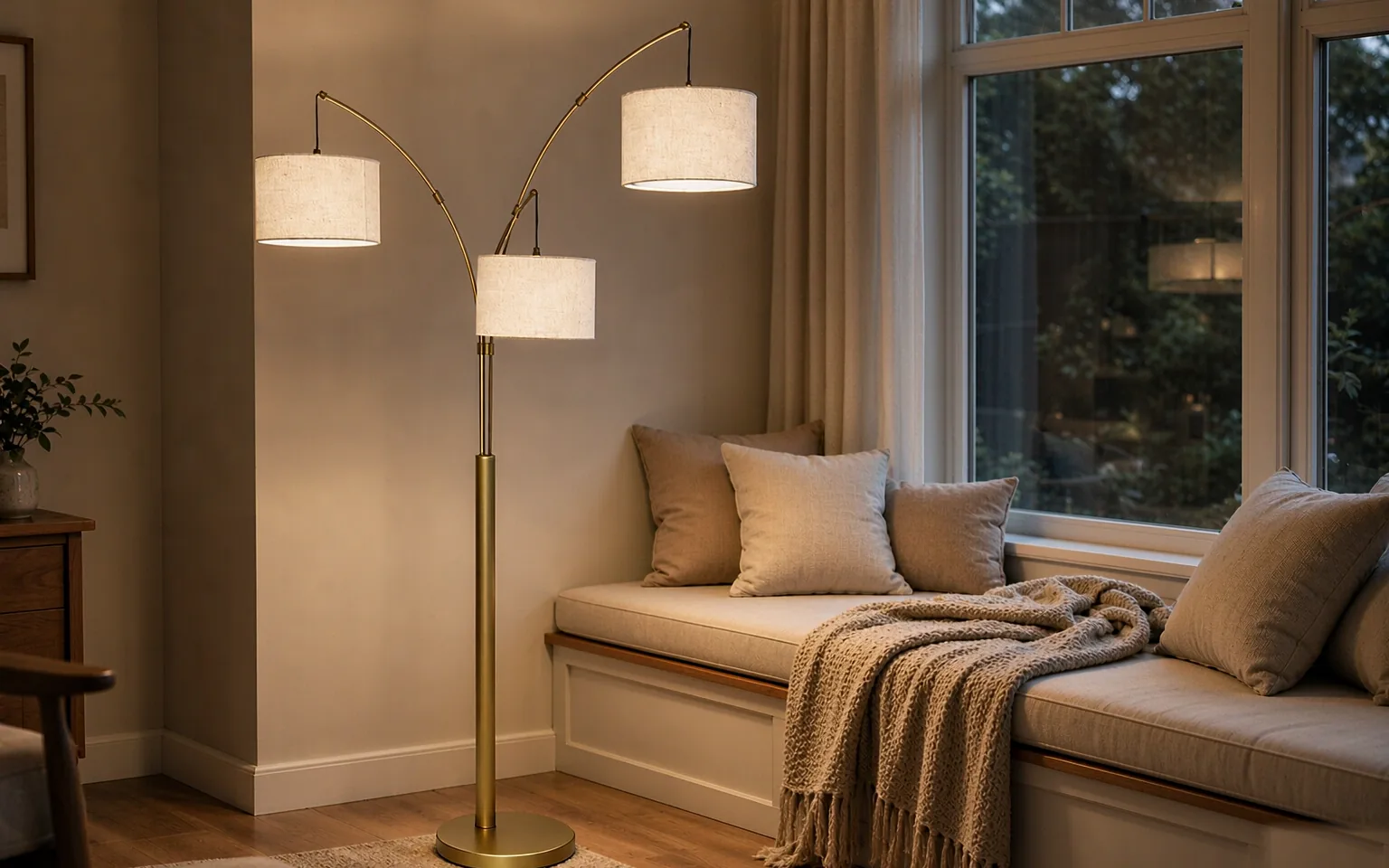
Accessibility guidance for lighting concentrates on illuminance and glare, and mostly omits the switch. In practice, an unreachable control turns the best-lit room into one that runs at whatever level it had when the occupant last got up.
The reach range that matters
Operable parts should be reachable from a seated position, generally between about 15 and 48 inches above the floor, with 15 to 44 inches the safer band for a user who cannot stand. A switch in the middle of a lamp cord satisfies this; a switch on a lamp head at 62 inches does not.
| Control location | Reachable seated | Verdict |
|---|---|---|
| Cord switch near the base | Yes, with the right cord length | Best for floor lamps |
| Rotary switch on the socket | Only on short lamps | Poor on a 64-inch lamp |
| Head-mounted touch control | No | Avoid |
| Foot switch | Yes, without bending | Good, if the pedal is large |
| Wall switch on a plug-in receiver | Yes | Excellent retrofit option |
Force, grip and feedback
A small rotary knob requires pinch grip and wrist strength. A rocker or a paddle requires a push. Where a user has limited hand function, a large contact area and a positive movement with an audible click is easier and more reliable than a smooth, continuous control with no detent.
Cordless lamps solve the reach problem entirely
A lamp that can be lifted and carried removes the question of whether the switch is reachable, at the cost of a charging routine. For a bedside lamp used by someone with limited mobility, that trade is often worth making.
Anti-glare and equal light
Accessibility is not only about controls. A shielded source, even illuminance without harsh pools, and a colour temperature consistent with the rest of the home all reduce the effort required to use a room, which is the purpose of the guidance in the first place.
Specify it into the product, not the installation
It is far cheaper to design a lamp with a cord switch at the right height than to adapt a room. Reach, force and feedback belong in the product specification, and a supplier who has never been asked the question will not have an answer ready.
Related reading
- Tunable White and Circadian Lighting Move From Offices to Li
- Lighting a Room That Has No Ceiling Fixture
Frequently asked questions
What makes lighting reachable for accessibility
Controls placed within easy reach, clear tactility, and simple operation help users with limited mobility or vision, so the switch or dimmer should not be hidden or high.
Should lamps have accessible controls
For public or care settings, yes. A lamp with a reachable, understandable control meets more users and supports accessibility expectations better than a fiddly one.
Does accessibility change the safety listing
No. The lamp still needs its ETL or UL listing to UL 153 with CSA C22.2 for Canada, and accessible controls are a design feature on top of that.
Sourcing lamps for your business?
We stock the Anrotix range in the United States — complete with LED bulbs and accessories — and supply from 10 units, mixed across SKUs.
Request wholesale pricingRelated product: Knob-dimmable 3-light arc floor lamp — control at reachable height, with no remote to lose
Recruiting regional partners worldwide — help@anrotix.cn