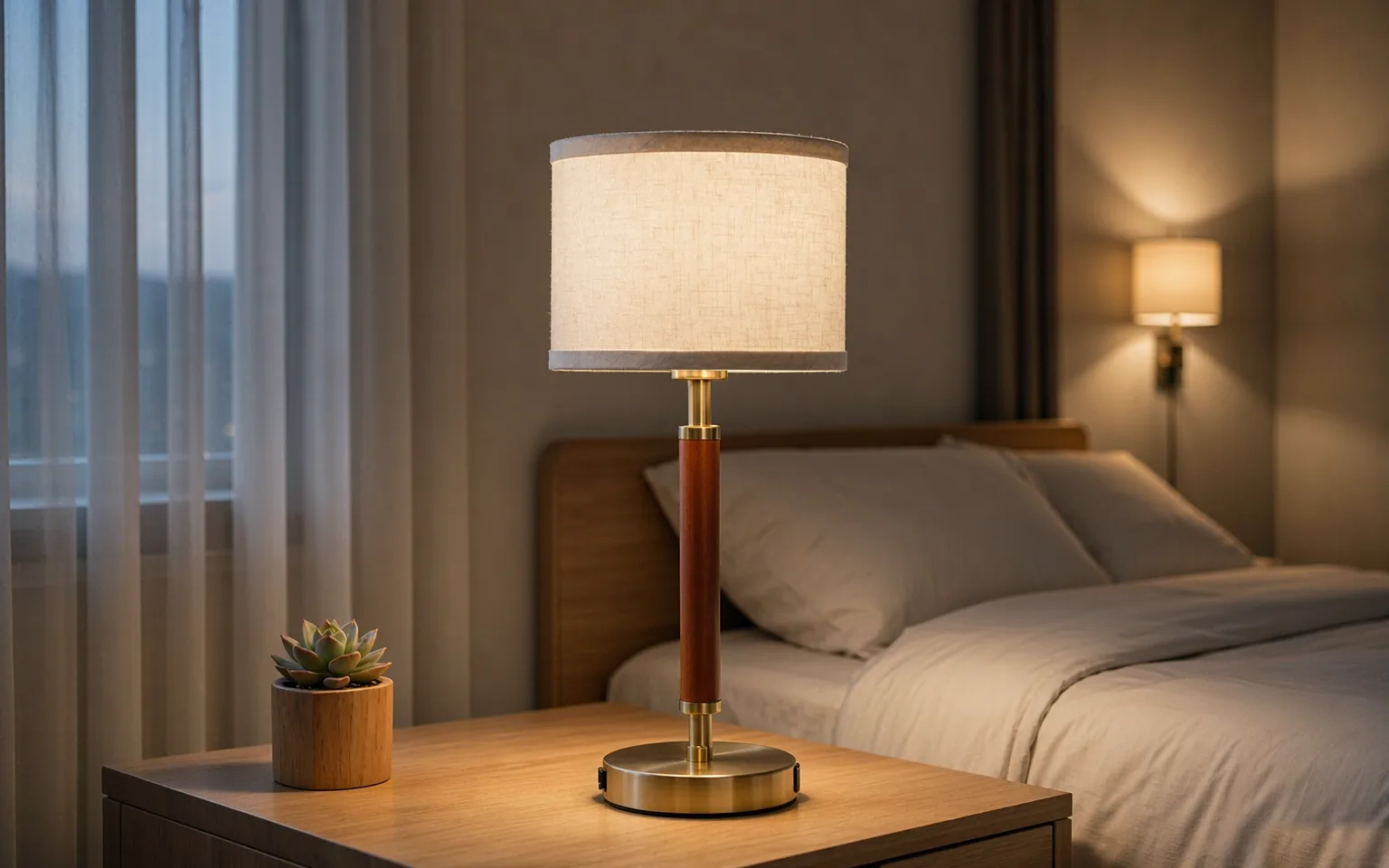
Hospitality buildings plan for a lot of failures and rarely plan for the obvious one: the lights going out. Hard-wired emergency lighting covers egress, but it does not cover the long, dim hours of a regional outage where guests are still in the building. Cordless rechargeable table lamps have quietly become the cheap insurance layer that sits between the emergency system and a fully dark floor.
Where cordless lamps fit the plan
Emergency lighting is built to get people out. It is not built to let a hotel keep serving, or let a resident eat dinner by something other than a phone torch. A cordless lamp on a nightstand or a lobby console keeps a usable pool of light exactly where people are, without drawing on the failing grid.
This is different from the cordless-as-novelty use case. Our Cordless Table Lamps Are Now a Hospitality Standard article covers the layout freedom they unlocked; the continuity use is the same hardware doing a second job.
The battery questions buyers forget
Runtime per charge and cycle life are the two numbers that decide whether a cordless lamp is continuity insurance or a maintenance headache. A lamp that needs charging every few hours is a staffing burden; one that holds a useful charge for a full evening and survives hundreds of cycles is a set-and-forget asset.
Shipping those batteries is a separate problem, and it is not minor. Our Shipping Cordless Lamps: The Lithium Battery Rules guide lays out why the freight mode changes the moment a product contains a rechargeable cell — relevant both to receiving stock and to sending replacements.
Specifying for the outage, not the showroom
For continuity use, warmth of light and a stable base matter more than the showroom pose. A lamp that sits calmly on a surface through a power cut, with a warm low output that does not dazzle, does more for guest confidence than a brighter, fussier unit. Extended-stay properties feel this first, because their guests are effectively at home during an outage.
Our Extended-Stay and Serviced Apartments piece looks at the longer-stay guest; the same lamp that earns its place there is the one worth reaching for when the grid drops.
What Anrotix stocks
We hold cordless and rechargeable portable lamps in United States stock, built to ETL listed to UL 153 and CSA C22.2, specified for 120V operation with US plugs. Orders start at a ten-unit wholesale minimum and can combine several SKUs in one shipment.
For an outage-continuity plan, tell us the room count and the runtime you want per charge and we will quote a mixed cart of cordless units sized to it — write to help@anrotix.cn with the model list and target quantities.
Frequently asked questions
Do cordless lamps replace emergency lighting?
No. They sit alongside it. Hard-wired emergency lighting is what the code requires for egress; cordless lamps keep occupied spaces usable during a longer outage that the emergency system was never meant to cover.
How long should a cordless lamp run on a charge?
That depends on the mode and the cell, but for continuity use the useful figure is a full evening at a warm low output, not a brief bright burst. Ask for runtime at the actual output you will use, because the headline number is usually measured at maximum.
Does the battery change how the lamp ships?
Yes. Rechargeable cells bring lithium-battery freight rules that can shift the shipment from standard parcel to a different mode. It matters both for receiving stock and for sending replacements to a property.
Sourcing lamps for your business?
We stock the Anrotix range in the United States — complete with LED bulbs and accessories — and supply from 10 units, mixed across SKUs.
Request wholesale pricingRelated product: the cordless table lamps held in United States stock — rechargeable portable lamps with E26-compatible fittings, orderable from ten units with mixed SKUs
Recruiting regional partners worldwide — help@anrotix.cn