Last reviewed: Sep 15, 2026
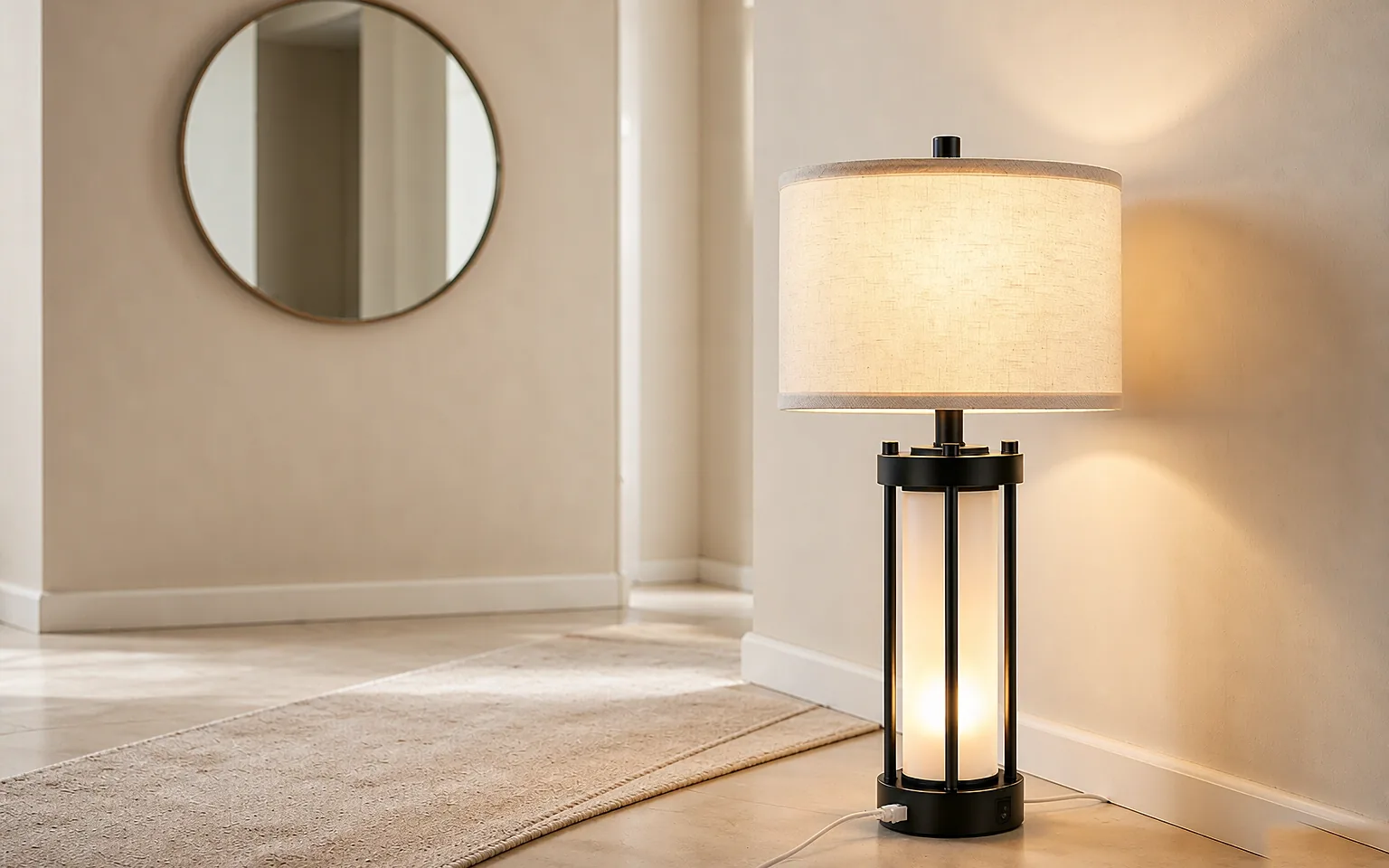
Most hospitality lighting guidance assumes a seated or standing guest. A treatment room inverts that: for most of the appointment the client is lying face up, looking at the ceiling, in a room that must feel calm and function clinically at the same time. Portable lamps are the right tool for that combination, and the specification is unusually specific.
The optical problem is different
A person lying on a treatment table looks directly at the ceiling and at anything above eye level. Any bare or poorly shaded source in that field of view becomes glare, and glare in a room designed for relaxation is a design failure regardless of the measured light level.
The practical consequence is that shade selection matters more here than almost anywhere else. A shade that is opaque enough to hide the source, dense enough to soften it, and positioned low enough to keep the source out of the reclined line of sight does more work than any amount of output tuning.
The second consequence is that a single overhead source is the wrong answer. Overhead is exactly where the client is looking. Portable lamps placed to the side, below the reclined sight line, produce the same working light without the glare.
Colour temperature and rendering in a calm room
Warm colour temperature is the correct default in a spa or treatment environment, and consistency across every source in the room matters more than the exact figure. A room with one lamp at a warm tone and one at a cooler tone reads as accidental even when each is pleasant alone.
Colour rendering deserves attention too. Treatment rooms involve skin, and a source with poor rendering makes skin look unwell. This is one of the few hospitality applications where the rendering conversation is an operational one rather than an aesthetic one.
CRI, Explained for People Who Have to Sign Off on a Sample covers what to ask for, and 2700K or 3000K? Choosing Colour Temperature for North American Interiors covers the choice of tone and how to keep it consistent across a property.
Dimming, heat and the practical details
Why Dimmable Lamps Still Buzz, Flicker or Drop Out is worth reading before specifying, because low-level dimming behaviour is the single most common complaint in this room type.
- Dimming is close to mandatory. The same room hosts a bright consultation moment and a near-dark treatment moment, and a lamp that cannot go low will be switched off instead, which is worse.
- Check dimming behaviour at the bottom of the range, not the top. Drop-out, flicker and buzz all appear at low levels, and a treatment room spends its time there.
- Watch heat at the lamp body. Therapists work close to the lamp and clients are still for long periods; a lamp that runs hot becomes a comfort problem even when it is safe.
- Stability matters more than usual because people move around the lamp in a small room, often with a trolley.
- Cleanability matters. Treatment rooms are cleaned frequently and with products that are not always gentle on finishes.
Planning the room
Two lamps usually beat one. A single lamp creates a gradient across the room that is fine for ambience and unhelpful for work; two lower-output lamps placed to either side of the table give the therapist even light and keep the source out of the client's view.
Place them below the reclined sight line, which in practice means lower than a designer's instinct for a living room. A floor lamp that would be correct beside a sofa is often too tall beside a treatment table.
Decide the control position by who uses it. If the therapist controls the light, the switch needs to be reachable from the working position, not from the door. That is a small specification detail and a daily irritation if it is wrong.
Plan the cord route before the room is finished. Treatment rooms are tight, the lamp often has to stand further from an outlet than the furniture plan suggests, and a cord across a walking route is both a trip hazard and the sort of detail an inspector notices. Specifying the right cord length at the outset is far cheaper than retrofitting.
Think about acoustics and product resistance. Treatment rooms see oils, lotions and frequent cleaning with agents that are harder on finishes than anything in a guest room. Ask what the finish is and how it behaves against those products before specifying, not after the first maintenance cycle.
Finally, plan the reorder. Spa rooms are refurbished on a different cycle from guest rooms, and a discontinued model in a treatment room is a visible mismatch. Choose a model with a stable finish and hold spares.
For samples to evaluate in a treatment room, or for a tiered quote on warm-toned low-glare models, email help@anrotix.cn with the room layout, the ceiling height and where the lamps can stand.
Frequently asked questions
Why not just use a dimmable ceiling fixture?
Because the client is lying down looking at the ceiling. Overhead placement puts the source in the reclined line of sight. Portable lamps at the side produce working light without that glare.
How warm should the light be?
Warm is the right default, and consistency across every source in the room matters more than hitting a particular number. Mixing tones in a small calm room is very noticeable.
What is the most common specification mistake here?
Specifying for a seated or standing person. Height, shade density and switch position all change when the occupant is lying down and the person controlling the light is standing beside them.
Sourcing lamps for your business?
We stock the Anrotix range in the United States — complete with LED bulbs and accessories — and supply from 10 units, mixed across SKUs.
Request wholesale pricingRelated product: a wood-bodied LED floor lamp — warm-toned, low-glare ambient model suitable for calm interiors; full specification on the product page
Recruiting regional partners worldwide — help@anrotix.cn