Last reviewed: Sep 15, 2026
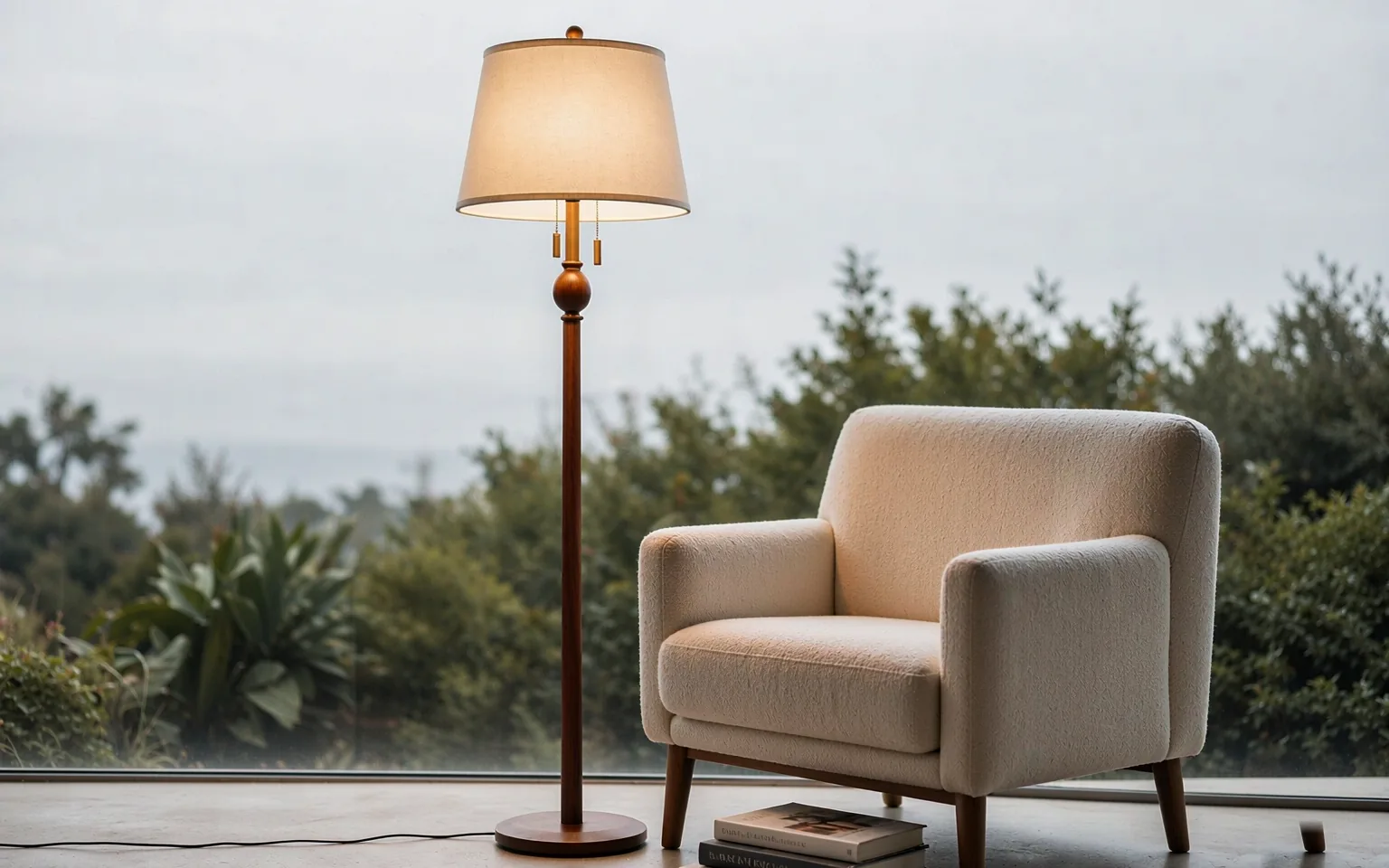
CRI answers one question: under this light, how close do colours come to how they look under a reference source? It is the most quoted number in lighting after lumens, and the one most often misunderstood by the people approving the sample.
What the scale measures
The index is built on eight pastel test colours, scored from 0 to 100 against a reference lamp of the same colour temperature. A score of 100 means the colours match. In practice, residential LED lamps run from about 80 to 98.
| CRI | Where you see it | What it means in a room |
|---|---|---|
| Below 80 | Low-cost bulbs and fixtures | Reds and skin tones look flat or grey |
| 80–85 | Most mass-market LED | Acceptable for utility lighting |
| 90–93 | Better residential and retail | Wood, fabric and food look natural |
| 95+ | Specifier grade | Critical in galleries, hospitality, apparel |
Why 90 is not automatically better than 85
Two lamps can both score 90 and render one specific colour very differently, because the score is an average. The extended test set, R9 to R15, exists for exactly this reason, and R9 in particular measures saturated red, which is what makes wood, brick and skin look alive.
R9 is the number nobody quotes
A lamp with CRI 85 and R9 above 50 will look better in a furnished room than a lamp with CRI 92 and R9 near zero. If a supplier cannot tell you R9, they have not tested it, and in most cases the answer is low.
Where it matters commercially
Retail, hospitality and any environment where product or people are judged by appearance. In a warehouse or a parking structure, CRI is a line item you can reduce without anyone noticing. In a restaurant with wood tables, it is the difference between the room looking expensive and looking tired.
How to evaluate a sample properly
Put the sample in the intended room, at night, with the other lights off. Look at skin, then wood, then food, then black fabric. Do not judge under daylight through a window, because your eye adapts to the daylight and the lamp never gets a fair hearing.
Photographs of a CRI 90 sample under a CRI 80 lamp will look worse than the product is. Never evaluate colour rendering from a phone photo.
Related reading
- How Many Lumens Does a Room Need? A Working Method
- 2700K or 3000K? Choosing Colour Temperature for North Americ
Frequently asked questions
What is CRI and why does it matter?
CRI (Colour Rendering Index) measures how accurately a light shows object colours versus natural light, on a 0 to 100 scale. Higher is better for spaces where colour judgement matters, such as retail, kitchens and art.
What CRI should I specify?
For most interiors, 80+ CRI is acceptable; specify 90+ where colour accuracy is important, such as showrooms or sample-review areas. Pair CRI with the right colour temperature.
Is a high CRI bulb always better?
Not always. CRI says nothing about efficiency or colour temperature. A 95 CRI bulb at the wrong Kelvin can still look wrong for the room, so choose CRI, Kelvin and lumens together.
Sourcing lamps for your business?
We stock the Anrotix range in the United States — complete with LED bulbs and accessories — and supply from 10 units, mixed across SKUs.
Request wholesale pricingRelated product: Solid wood LED floor lamp — worth sampling in person before you sign off a colour-critical order
Recruiting regional partners worldwide — help@anrotix.cn