Last reviewed: Sep 15, 2026
Lamp listings are full of numbers: lumens, colour temperatures, CRI values, wattage equivalents, lifespans. Each is a claim, and claims carry an expectation that the seller can back them up if asked — by a marketplace, a retailer's compliance team, or a regulator. The framework behind this is simple and old: advertising must be truthful, not misleading, and substantiated. What trips sellers up is not the principle but the plumbing — which numbers are measured, which are inherited from a supplier, and which drifted somewhere between the spec sheet and the listing.
The core rule: claims need substantiation
In the United States, the governing expectation is that advertisers must have a reasonable basis for objective claims before making them, and the depth of that basis scales with the claim's specificity. A precise number — a stated lumen output, a stated lifespan — needs a real measurement or a documented source behind it. A vague impression needs less, but vague impressions sell lamps poorly, so sellers end up in the precise-number business whether they planned to or not.
The practical discipline is provenance: for every number on your listing, know where it came from. Measured on the product? Stated by the manufacturer, with a test report available? Inherited from a bulb specification rather than the lamp? Sellers who can answer that question per number can answer a marketplace's challenge in an afternoon; sellers who cannot rebuild the listing from scratch.
The numbers lamp listings get wrong
Wattage equivalence is the classic. An "equivalent to a 100-watt bulb" claim is a comparison claim, and comparison claims need the comparison to be real — which is why our wattage equivalence explainer treats those labels as marketing, not physics. The safer formulation is to state the measured lumens and let buyers do the comparison, or to use the equivalence only where a documented basis exists.
Lifespan ratings have the same trap in a different costume: a rated lifespan is a projection from testing, not a promise each unit will reach it. Our L70 and B10 explainer decodes the notation so listings can state ratings accurately. And colour rendering claims should distinguish measured values from impressions — our CRI explainer and the lumens per room method give buyers the tools to check the numbers themselves, which is exactly the scrutiny your listing should expect.
Photos are claims too
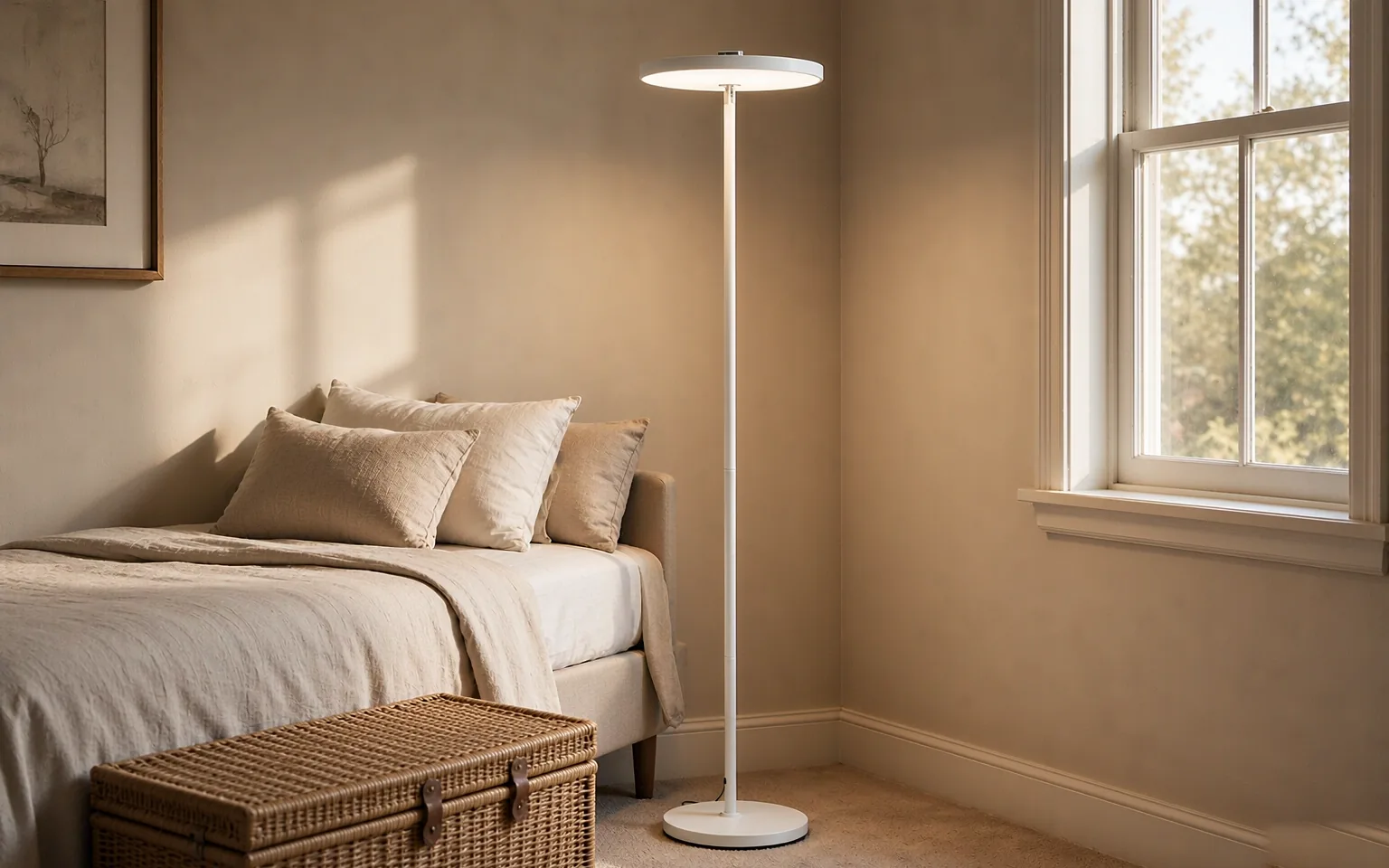
Product photography makes implicit claims that text never has to: that the shade is that colour, that the finish is that texture, that the lamp looks like that in a room. Marketplaces increasingly treat visual mismatch as a listing defect, and returns data punishes it more efficiently than any regulator — a customer who unboxes a different-looking lamp returns it and reviews it.
The working rules are unglamorous: photograph the actual product, keep colour within honest rendering limits, show scale cues for lamps whose size surprises people, and photograph the configuration being sold — a three-head arc lamp shown with three shades should ship with three shades. Our included LED bulb guide matters here too, because "bulbs included" claims should say which bulbs, at what specification.
Inheriting claims from your supplier
Most sellers repeat some claims sourced from manufacturers. The inheritance is legitimate when it is documented: ask for the basis of each performance number you intend to publish, and file it with the product records. Our marketplace compliance documents guide lists the document set marketplaces ask for; a claims substantiation file is the same discipline applied to marketing rather than compliance.
The failure pattern to avoid is silent drift: a spec changes on the production line, the supplier updates their sheet, and your listing keeps last year's numbers. Tie listing claims to a source document with a version, and re-verify when the product changes — our specification change control guide describes the mechanism from the buying side.
The Anrotix approach to claims
Anrotix writes specification data so buyers can reuse it without embellishment: published dimensions, outputs, bases and included-bulb specifications for every model in the range, which our floor lamp comparison page lays out side by side. The compliance position is stated plainly — our portable-luminaire range is built to ETL listed to UL 153 and CSA C22.2 — and we do not ask buyers to carry claims they cannot source.
If you need the specification basis for a listing you are writing, write to help@anrotix.cn with the model list and the fields you intend to publish. We will confirm what is documented and what should be worded differently.
Frequently asked questions
Do I need test reports for every number on my lamp listing?
You need a reasonable basis for each objective claim. For specific numbers — lumens, lifespans, dimensions — that means a measurement or a documented manufacturer source you can produce if challenged. Know the provenance of every number you publish.
Can I use wattage equivalence in my listings?
Only where the comparison has a documented basis. Equivalence labels are marketing shorthand, not physics. Stating measured lumens directly is safer and gives buyers a number they can verify.
What about claims the manufacturer gave me?
Inheriting claims is fine when documented. Ask for the basis of each number you intend to publish, file it with the product records, and re-verify whenever the product specification changes so your listing never drifts from the source.
Sourcing lamps for your business?
We stock the Anrotix range in the United States — complete with LED bulbs and accessories — and supply from 10 units, mixed across SKUs.
Request wholesale pricingRelated product: compare the Anrotix floor lamp range — specifications stated plainly, so your listings can repeat what the product actually is
Recruiting regional partners worldwide — help@anrotix.cn