Last reviewed: Sep 15, 2026
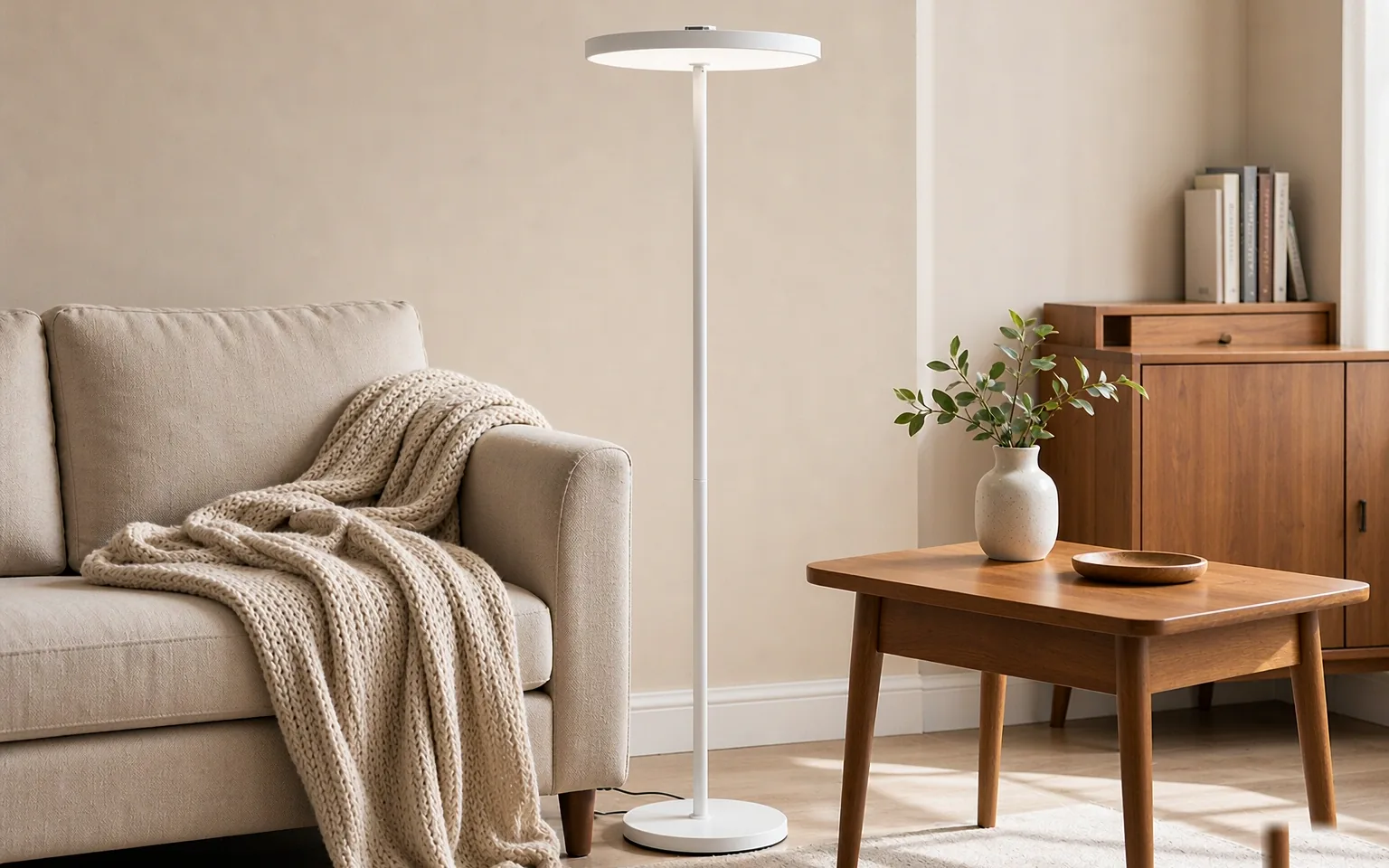
Nobody buys a floor lamp for its base, and the base is nonetheless what determines whether the lamp works in the room. It decides how much floor space the lamp consumes, whether it can slide under a sofa, whether a wheelchair or a vacuum can pass it, and whether it stays upright when a guest leans on it or a cleaner moves it. Three families cover almost everything on the market — the flat disc, the tripod or legged base, and the weighted column — and each suits a different room and a different buyer. This article compares them on the criteria that matter at specification time, with the trade-offs stated plainly.
The flat disc
The flat disc, usually a circular or slightly domed plate with the column rising from its centre, is the default for good reason. It is the lowest-profile option, it slides under seating, and it is forgiving of being placed on a rug. Its limitation is geometric: stability comes from mass, so a disc on a tall lamp has to be genuinely heavy, and a disc on a cantilevered lamp has to be heavier still.
Specify a disc where floor space is contested — small apartments, hotel rooms, anywhere a lamp has to tuck beside a sofa or a chair — and where the lamp will be moved occasionally but not constantly. It is the safest default for a general-purpose assortment.
The tripod and the legged base
Legged bases achieve stability through width rather than mass, which makes them lighter for the same resistance to tipping and gives them a deliberate appearance that some programmes want. They also consume more floor area, they catch a vacuum cleaner, and their feet are the part most likely to arrive bent or to damage a soft floor.
They suit rooms where the lamp is meant to be seen and where there is space around it: a corner, a reading nook, a lobby seating group. They suit less well anywhere people move furniture frequently or where floor space is tight. Check the feet: whether they are capped, whether they are adjustable, and whether the adjustment survives being dragged.
| Base type | Floor footprint | Best used where |
|---|---|---|
| Flat disc | Small; slides under seating | Apartments, bedrooms, beside sofas, hotel rooms |
| Tripod or legged | Wide; visible by design | Corners, reading nooks, lobbies with space |
| Weighted column | Moderate; mass concentrated low | Tall or cantilevered lamps, high-traffic rooms |
The weighted column
Some designs build the mass into the lower column rather than the base plate, giving a narrower visual footprint with real stability. This is the construction to look for on tall lamp standards and on anything with an arm that reaches away from the column, because it puts the mass low and close to the centre line.
It is also the construction that matters most in public and contract settings. The stability question is not academic — a lamp that tips in a lobby or a guest room is a safety incident and a claim, and the underlying mechanics are set out in the engineering behind an arc lamp that does not tip.
- Measure the base diameter against the gap you actually have beside the seating, not against a floor plan
- Check the underside: a felted or capped base protects hard floors and slides on rugs
- Check whether the lamp can be levelled on an uneven floor, and whether that adjustment holds
- Lift it: if a lamp is too heavy to move, it will not be moved, and it will be placed once and left
- Look at the cord exit — a cord leaving the base at the wrong point dictates where the lamp can stand
- Consider who will move it: a housekeeper, a guest, or nobody at all
Choose the base for the person who will move the lamp, not for the person who will buy it. Those are usually different people, and the mover is the one who files the complaint.
Matching the base to the room
Three room types recur and each has a natural answer. In a bedroom or a small apartment, the flat disc wins on footprint and because a lamp that slides under a bedside table or a sofa arm is a lamp that gets used. In a living room with a reading chair, a legged base can work because the lamp is part of the composition and there is space around it. In a lobby or a public room, the weighted column is usually right because stability in traffic outweighs every other consideration.
Where a lamp has to light a seating area from behind or beside it, check the height as well as the base — the working heights are in what height a floor lamp should be — and be aware that the most common placement fault is a lamp that looks right in the photograph and sits in the wrong place in the room, as described in floor lamp placement mistakes.
What to check before you sign off
The check is physical, not visual. Put the lamp on the floor it will stand on, push the top gently the way a guest or a child would, and see how it behaves. Try it on carpet as well as on a hard floor, because a base that is stable on one can rock on the other. If the lamp has an arm, extend it fully and repeat the test.
Then check the base against the cleaning route: can a vacuum pass it, can it be moved without lifting, and does the cord stay out of the walking line. These are the questions that generate returns and complaints long after the appearance question has been settled.
Building an assortment across base types
A balanced range does not need every base type in every finish, but it should cover the three room types above. If you are choosing models to cover a floor plan rather than a mood, start from the floor lamp comparison page and match each model to a placement before matching it to a price point.
For help matching bases to a specific floor plan or property type, send the room list and the constraints to help@anrotix.cn, or use the wholesale enquiry form — orders ship from ten units and can be mixed across models, so a first assortment can cover several placements without over-committing to any one.
Stability is the specification nobody asks about until a lamp falls over. Test it on the actual floor, with the arm extended, before the range is approved.
Frequently asked questions
Which base type is most stable?
It depends on the lamp rather than the type. A wide legged base and a heavy weighted column are both stable for different reasons; the flat disc is stable when it is properly weighted. Test the specific model rather than generalising from the type.
Can a floor lamp sit on carpet?
Yes, but it behaves differently from a hard floor. A base that sits flat on wood can rock on a deep pile, and some designs include levelling for exactly this reason. Test on the floor covering you actually have.
How much floor space should I allow for a floor lamp?
Measure the base diameter and add clearance for the shade or head overhang, which is usually the larger dimension. For legged bases, measure the footprint across the feet rather than the column.
Sourcing lamps for your business?
We stock the Anrotix range in the United States — complete with LED bulbs and accessories — and supply from 10 units, mixed across SKUs.
Request wholesale pricingRelated product: Compare the Anrotix floor lamp range — a side-by-side of the range, including heights and footprints, to match bases to placements
Recruiting regional partners worldwide — help@anrotix.cn