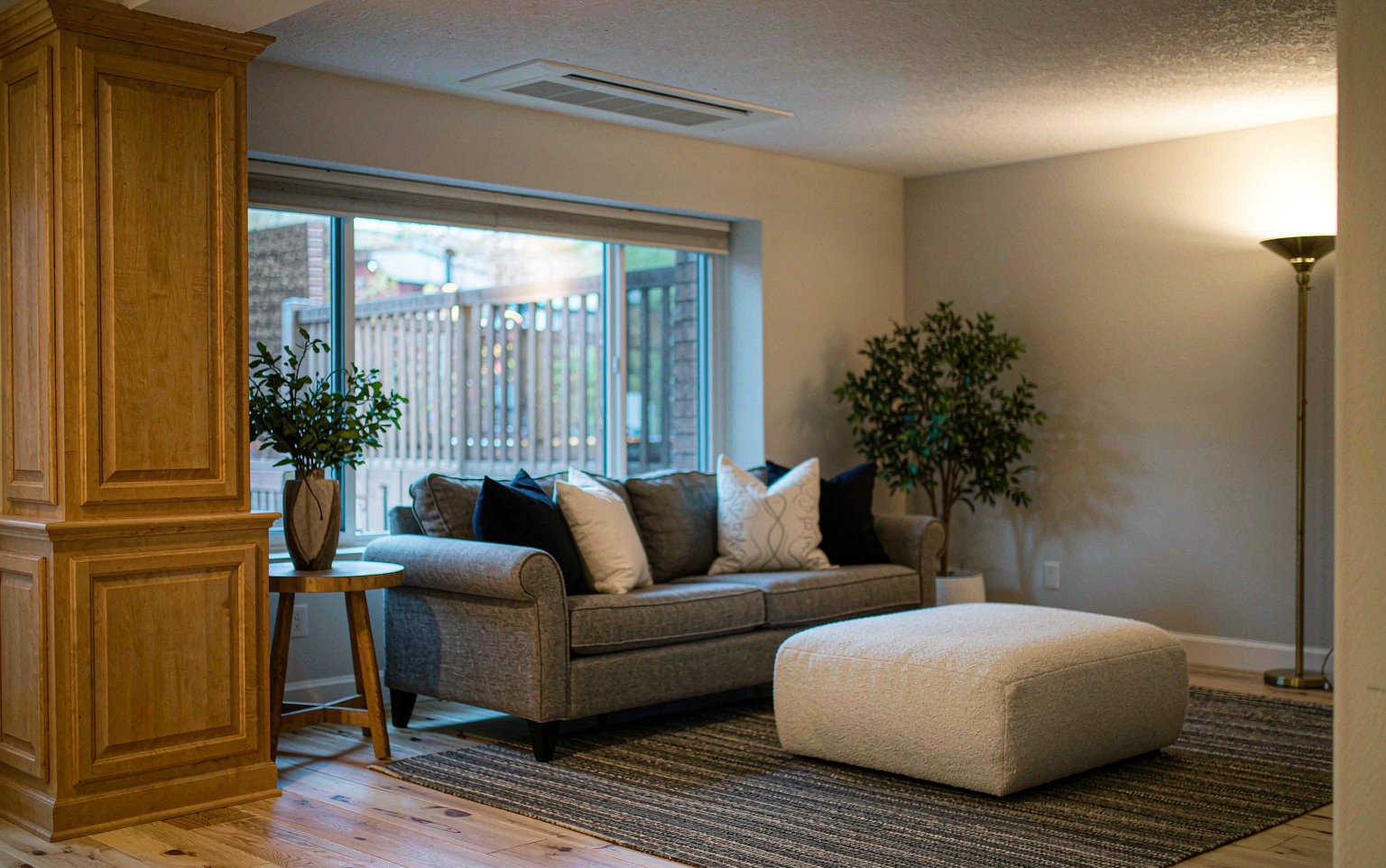
Colour rendering index has been the default number for decades, and it has a known weakness: it is computed from a small set of pale test samples, so a source can score well while still making real rooms look flat. TM-30 was written to close that gap, and it gives buyers two numbers instead of one.
The two numbers
Rf is a fidelity score from 0 to 100, describing how closely colours match a reference source. Rg is a gamut score describing whether colours are rendered more or less saturated than that reference. A lamp can score high on fidelity and slightly compress saturation, which is exactly the combination that makes a room feel slightly wrong.
TM-30 evaluates against a far larger sample set than the older method uses, which is why it catches behaviour the single-number index misses.
| Metric | Reads as | Practical guidance |
|---|---|---|
| Rf | Fidelity, 0–100 | Higher is more accurate; treat low eighties as a warning for interiors |
| Rg | Saturation gamut, around 100 | Near 100 is neutral; well below drains reds and wood tones |
| R9 | Deep red rendering | Still worth asking for separately; it is the one people notice on skin and timber |
Why a buyer should care about a number customers never see
Because it predicts the review. A lamp that renders wood furniture and skin tones poorly does not generate a technical complaint. It generates a vague one-star review saying the light feels cheap, and no amount of marketing fixes that.
Colour quality is the specification customers cannot name but always notice. It shows up in the return reason as taste, not as physics.
How to ask without starting a fight
Most factories still quote the older index because that is what most buyers ask for. Requesting Rf, Rg and R9 alongside it costs nothing, and the suppliers who answer immediately are usually the ones who already measure them.
Frequently asked questions
Does TM-30 replace CRI?
Not formally. The older index is still embedded in regulations and in most catalogues. TM-30 is best treated as an additional lens, and it is increasingly the one used when two samples are being compared side by side.
What counts as a good Rg?
Values around 100 mean saturation is close to the reference. Slightly above is often pleasant in residential spaces; noticeably below tends to flatten warm materials such as wood, leather and skin.
Sourcing lamps for your business?
We stock the Anrotix range in Fontana, California — complete with LED bulbs and accessories — and supply from 10 units, mixed across SKUs.
Request wholesale pricingRelated product: Solid Wood LED Floor Lamp, 3 Colour Lights — a case where colour rendering decides whether the timber reads warm or dull
Recruiting regional partners worldwide — help@anrotix.cn